A dead battery on the Gardiner, a warning light in North York, or a disabled EV in a condo parking garage is not the time to guess what kind of tow truck you need. This EV towing service guide is built for drivers who need clear answers fast. Electric vehicles are not towed the same way as many gas cars, and using the wrong method can turn a roadside problem into expensive drivetrain damage.
If your EV stops moving, the first priority is safety. Pull over if the vehicle still has enough power to do so. Turn on your hazard lights, move away from traffic if it is safe, and contact a towing company that understands electric vehicles. Speed matters, but the right equipment and the right towing procedure matter just as much.
Why an EV towing service guide matters
Many drivers assume towing is towing. With electric vehicles, that can be a costly mistake. Some EVs should not be pulled with two wheels on the ground, and some need a flatbed to avoid damage to the motor, regenerative braking system, or battery-related components. The issue is not that EVs are fragile. The issue is that they are engineered differently.
That difference affects what kind of truck should be dispatched, how the car is loaded, whether dollies are needed, and where the vehicle can safely be recovered from. It also affects what the driver should tell dispatch. A basic “my car broke down” call may not give the towing operator enough information to send the right setup on the first trip.
For busy Toronto drivers, first-time EV owners, and commercial drivers losing time on the road, that delay matters. You want a company that can ask the right questions, send the proper equipment, and keep the situation calm from the first call.
EV towing service guide: what makes EV towing different
The biggest difference is the drivetrain. In many electric vehicles, the wheels are mechanically connected to electric motors in a way that makes improper towing risky. If the vehicle is dragged incorrectly, those components can be damaged even if the tow is short. That is why flatbed towing is often the safest choice.
Ground clearance can also be an issue. Many EVs sit low and carry heavy battery packs under the floor. Loading angles matter. A careless approach can scrape body panels, damage underbody shielding, or create avoidable battery pack risk. Experienced operators account for this by using the right loading technique and equipment.
Then there is the recovery environment. An EV stuck in underground parking, stopped in a live traffic lane, or disabled after a collision may require a different plan than a vehicle parked neatly at the curb. The best towing response depends on the model, the location, and the condition of the vehicle.
When your EV needs a tow right away
Not every EV issue means the car must be towed. Sometimes the vehicle has enough remaining function to move to a safer place, and sometimes the problem is minor. But there are situations when calling for immediate towing is the smart move.
If the car will not shift into drive, shows a serious drivetrain or battery system warning, has been in a collision, or has a flat tire without a safe roadside solution, do not force it. The same applies if the steering feels abnormal, the vehicle loses power suddenly, or you see signs of underbody impact. Water exposure is another major concern. If your EV has been through deep flooding, have it professionally assessed before attempting to drive it.
A low 12-volt battery can also leave an EV stranded even when the main battery still has charge. In some cases, roadside assistance may help with that. In others, towing is the safer next step, especially if system warnings are stacking up or the car remains unresponsive.
What to tell dispatch when calling for EV towing
A fast tow starts with accurate information. Tell dispatch that you drive an electric vehicle right away. Then share the make and model, your exact location, and whether the vehicle is in traffic, in a garage, in a parking structure, or at home.
It also helps to mention whether the vehicle powers on, whether it can roll freely, and whether it was involved in a collision. If you have a flat tire, underbody damage, or a locked electronic parking brake, say so. Those details affect truck selection and loading strategy.
If you are not sure what is wrong, that is fine. You do not need to diagnose the car. You just need to describe what you see. Warning messages, sounds, impact damage, smoke, or charging issues all help the towing team prepare.
The safest towing method for most EVs
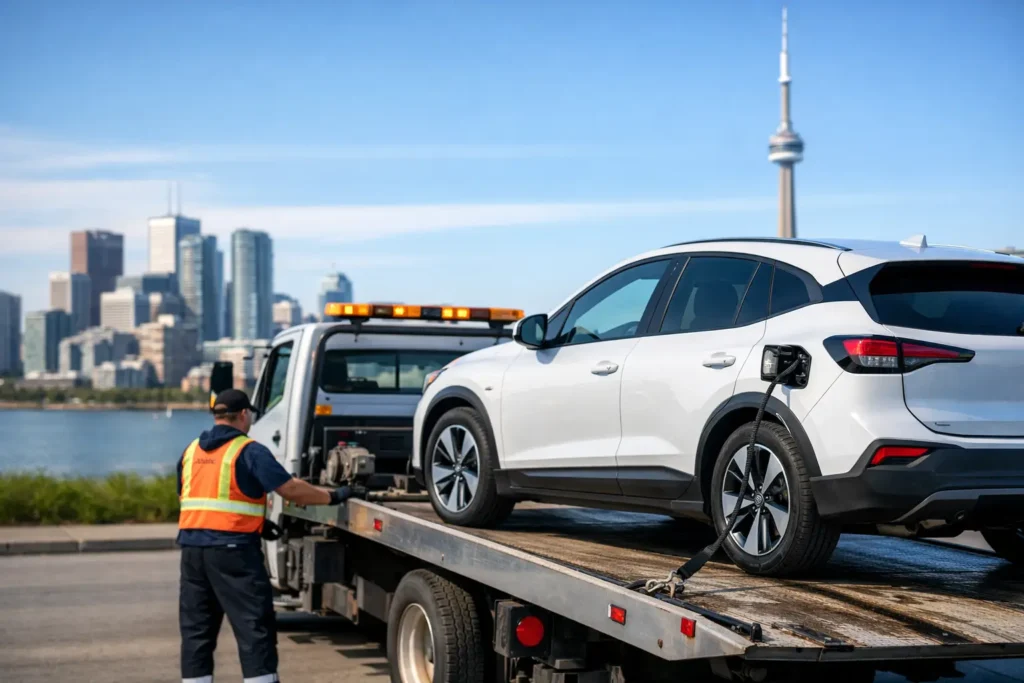
For many electric vehicles, flatbed towing is the preferred method. It keeps all four wheels off the ground and reduces the chance of drivetrain damage during transport. It is also generally the best option when the vehicle has unknown mechanical issues, collision damage, or a disabled wheel.
That said, not every roadside situation is simple. Tight parking garages, blocked lanes, or difficult angles can require special handling before the car can even get onto a flatbed. In those cases, the operator may need to reposition the vehicle carefully using specialized equipment.
This is where experience matters. A licensed, insured operator who regularly handles EVs will know when flatbed transport is straightforward and when the recovery needs an adjusted approach. Fast service is important, but careful loading is what protects the vehicle.
What drivers should avoid during an EV breakdown
The first thing to avoid is assuming a friend with a tow strap can help. Improvised towing is risky with any vehicle and especially risky with an EV. You can damage the car, create a traffic hazard, or make recovery harder once a professional arrives.
You should also avoid forcing the vehicle to move if it is showing major fault warnings or feels mechanically wrong. Do not keep attempting to drive on a damaged tire or after a hard underbody strike. If the vehicle was in a crash, avoid touching visibly damaged high-voltage components or exposed wiring.
Another common mistake is giving too little information on the call. If dispatch does not know it is an EV, the wrong truck may be sent. That slows everything down when you are already stuck.
Choosing the right towing company for an EV
Not every towing service is equally prepared for electric vehicles. Ask whether they offer flatbed towing, whether they handle EVs regularly, and whether the operators are licensed and insured. If your vehicle is in a difficult location, ask whether they can recover from underground garages, condos, or narrow downtown streets.
Transparent pricing matters too. When drivers are under stress, vague quotes create more stress. You want clear communication about dispatch, arrival time, and the likely towing method. A reliable roadside company should sound organized on the phone, not uncertain.
For Toronto-area drivers, local dispatch coverage can make a real difference. A company familiar with Downtown Toronto, Etobicoke, Scarborough, North York, East York, Little Italy, and Parkdale can often coordinate faster and more efficiently than a generic call center with no local knowledge.
After the tow: where should your EV go?
That depends on the problem. If the issue is a flat tire, minor roadside failure, or non-collision mechanical problem, you may want the car taken to a service center, tire shop, dealership, or your home. If the EV was involved in a crash, you may need a collision repair facility equipped to handle electric vehicles.
If you are unsure, ask before the truck arrives. A good dispatcher can help you think through the next step instead of rushing you into a choice. The goal is not just getting the car off the road. The goal is getting it to the right place without wasting time or causing more damage.
Emergency Roadside Service by South Toronto understands that when an EV stops, the driver usually needs more than a truck. They need fast direction, honest communication, and a towing team that knows what to do from the first call.
EV towing service guide for peace of mind
The best time to think about EV towing is before you need it. Save a trusted local towing number in your phone, know your vehicle model, and understand that flatbed towing is often the safest route for electric cars. When trouble hits, those small steps can save time and protect your vehicle.
Breakdowns are stressful, but the response should not add to that stress. If your EV is disabled, focus on staying safe, giving dispatch the right details, and choosing a towing company that treats your vehicle with the care it requires. The right help does more than move the car – it gets you out of a bad situation with less risk, less delay, and more confidence.