A breakdown never happens when you have extra time. It happens on the Gardiner in traffic, in a dark parking lot after work, or on a cold morning when your car will not start. That is exactly why knowing how to prepare for roadside assistance matters before anything goes wrong. A few simple steps can help you get faster service, stay safer at the roadside, and avoid making a stressful situation worse.
When drivers call for help, the biggest delays usually come from missing details, unsafe vehicle positioning, or not knowing what service they actually need. The good news is that most of that can be fixed ahead of time. Preparation does not need to be complicated. It just needs to be practical.
How to prepare for roadside assistance before you need it
The best time to prepare is when your vehicle is working normally. Once you are stuck on the shoulder with low battery on your phone and cars flying past, even simple tasks feel harder.
Start with the basics inside your vehicle. Keep your registration, insurance, and ID easy to reach. If you call for roadside help, you may need to confirm your vehicle details quickly. It also helps to know your car’s make, model, year, color, and plate number without having to think about it under pressure.
Your phone matters just as much as your spare tire. Keep it charged, and keep a car charger in the vehicle at all times. If you rely on battery-heavy apps for navigation or work, a portable power bank is worth having. A dead phone can turn a routine roadside call into a much longer wait.
It also helps to save one reliable roadside service number in your contacts before you need it. Do not wait until you are stranded to start comparing providers. In an emergency, drivers often end up calling the first number they see, without checking response times, service coverage, or pricing approach.
Build a small emergency kit that actually helps
A good roadside kit is not about packing your trunk with tools you do not know how to use. It is about carrying the items that protect you while help is on the way.
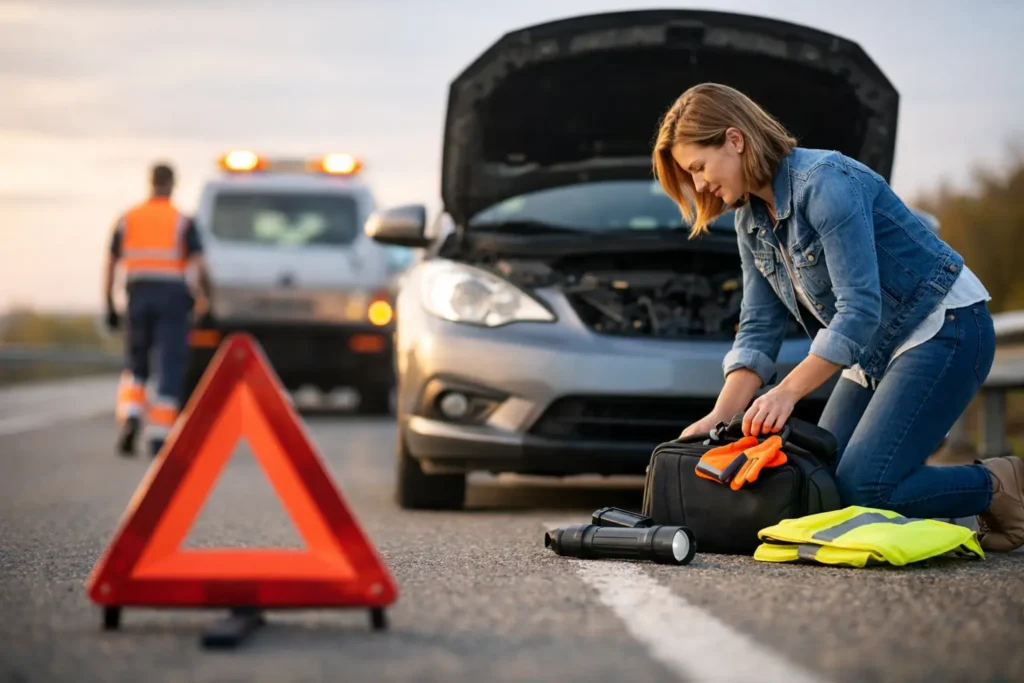
A flashlight, reflective triangles or road flares, a phone charger, warm gloves, and a basic first aid kit are useful in almost every season. In colder areas, add a blanket, winter hat, and something waterproof to kneel on if you need to check a tire. In warmer months, bottled water matters more than many drivers realize, especially if you are stuck waiting in direct sun.
If you drive long distances, transport family members, or use your vehicle for deliveries, your kit should be a little more complete. Keep jumper cables if you know how to use them safely, a tire pressure gauge, and a small air compressor if that fits your routine. But there is a trade-off here. Carrying equipment is helpful only if you can use it safely. If you are unsure, your first move should be to call for professional assistance, not experiment on the side of the road.
Know what roadside service you may actually need
Not every vehicle problem calls for a tow truck, and not every roadside issue can be solved where the car sits. Knowing the difference saves time.
If your battery is dead, a jump start may be enough. If you have a flat tire and a usable spare, a mobile tire change may solve it. If you locked your keys inside, lockout service is the right call. If you ran out of gas, fuel delivery is faster than arranging a tow. And if your car has been in a collision, has major mechanical damage, or cannot be moved safely, towing is usually the correct service.
This matters because dispatch depends on accurate information. The equipment used for a dead battery is different from the equipment used for accident towing or EV towing. Electric vehicles, in particular, need proper handling. Some can be damaged if towed incorrectly, so it is important to tell the dispatcher right away if you drive an EV, all-wheel drive vehicle, motorcycle, or commercial vehicle.
What to do first when your car breaks down
If your vehicle starts failing while you are driving, your first priority is location, not diagnosis. Signal early, reduce speed carefully, and move as far off the road as possible. If you can reach a parking lot, side street, or wide shoulder, do that. If the vehicle is not safe to move, stop in the safest available spot and turn on your hazard lights immediately.
Once you are stopped, take a quick look around. Are you near moving traffic, on a curve, under poor lighting, or in a construction zone? Those details matter when deciding whether to stay inside the vehicle or step out. In many roadside situations, especially on high-speed roads, staying inside with your seat belt on is safer than standing nearby.
If you have reflective markers and it is safe to place them, use them. If conditions are dangerous, skip that step and keep yourself protected. Your safety comes before the vehicle.
The information that speeds up dispatch
One of the most useful parts of learning how to prepare for roadside assistance is knowing what to say when you call. Clear information helps the dispatcher send the right operator without back-and-forth delays.
Be ready with your exact location or the closest possible landmark. Highway direction, exit number, nearby intersection, parking garage level, or business name can make a big difference. “I am somewhere in North York” is much less helpful than “I am on the southbound shoulder near the Lawrence exit.”
You should also be ready to describe the problem in simple terms. Say what happened, what the vehicle is doing now, and whether it is blocking traffic or stuck in a garage. Mention anything unusual such as smoke, leaking fluid, collision damage, or a wheel that appears broken. If the car will not start, say whether the dashboard lights come on. Small details help narrow down the type of service needed.
Finally, tell the dispatcher anything that changes access. Maybe your car is in underground parking with height limits. Maybe you are driving a pickup with a trailer. Maybe the steering is locked. These details affect what truck can reach you.
Safety while waiting for roadside assistance
Waiting is often the hardest part because it feels passive. But there is still plenty you can do to stay protected.
Keep your phone nearby and available for calls from dispatch or the driver. If you are in a safe place away from moving traffic, stay visible. At night, interior lights can help the operator spot your vehicle once they arrive. If you are on a highway shoulder or any busy road, remain cautious about opening your door or walking around the vehicle.
If a stranger stops and offers help, use judgment. Some people mean well, but you do not have to accept roadside assistance from an unknown person. It is usually safer to stay with the service you contacted and wait for the licensed operator assigned to your call.
If you feel unsafe because of your surroundings, not just the breakdown, tell dispatch. A good roadside service team understands that the situation is not only mechanical. Personal safety matters too.
A few mistakes drivers make under pressure
The most common mistake is giving a vague location. The second is misreporting the problem because the driver feels rushed. If you are not sure what failed, say that. It is better to be honest than guess wrong and slow down the response.
Another common issue is standing too close to traffic while inspecting the vehicle. Unless you are in a clearly safe spot, do not put yourself at risk to confirm what is already obvious. A flat tire, dead battery, or collision damage can be handled once help arrives.
Some drivers also wait too long to call. They hope the car will restart, the tire will hold, or someone nearby will solve it. Sometimes that works. Often it just turns a manageable roadside call into a longer and more expensive problem.
Prepare for roadside assistance if you drive often
If you commute daily, drive for work, or travel across Toronto and nearby areas at all hours, preparation should go a step further. Keep your fuel level from running too low. Replace aging batteries before winter pushes them over the edge. Check your spare tire pressure occasionally, because many drivers discover too late that the spare is flat too.
It also helps to think about who may be in the car with you. Families may want snacks, water, and extra layers. Commercial drivers may need to keep customer delivery information accessible if delays affect their schedule. The right preparation depends on how you use your vehicle.
For drivers who want fast, reliable support when things go wrong, a local service with 24/7 dispatch makes the biggest difference. Emergency Roadside Service by South Toronto is built around that reality – quick response, clear pricing, and professional help when drivers need it most.
The goal is not to expect the worst every time you turn the key. It is to make sure one bad moment on the road does not turn into three bad hours. Prepare once, keep your essentials in the car, and if trouble hits, focus on safety first and call for help right away.