A breakdown rarely gives you a warning. One minute you are heading through Toronto traffic, trying to get home, make a delivery, or pick up the kids, and the next minute your car is losing power on the shoulder. This driver guide to emergency towing is built for that moment – when you need clear steps, fast decisions, and a safe way to get your vehicle off the road.
What counts as an emergency towing situation?
Not every vehicle problem needs a tow truck, but many do. If your car will not start because of a dead battery, a jump start may solve it. If you have a flat tire and a safe spare, a mobile tire change might be enough. But when the vehicle cannot be driven safely, towing becomes the right call.
That usually includes engine failure, transmission problems, overheating that does not stop, collision damage, steering issues, brake failure, or a flat tire in an unsafe location. It also includes situations where the car technically moves, but driving it would risk more damage or put you in danger. A vehicle that drifts, leaks heavily, makes grinding sounds, or shows major warning lights after an accident should not be pushed any farther than necessary.
The best rule is simple: if there is any doubt about safety, stop and call for professional help.
First steps before emergency towing arrives
Your safety comes first, not the vehicle. If the car is still moving, steer it to the shoulder, a nearby lot, or any safer area away from active traffic. Turn on your hazard lights right away. If it is dark, rainy, or visibility is poor, those flashers matter even more.
If you are on a busy road or highway, stay alert about where you stand. In many cases, it is safer to exit the vehicle from the side away from traffic and wait behind a barrier or well off the roadway. If the vehicle is in a dangerous position and you cannot safely get out, stay buckled in and call for help immediately.
Once you are safe, gather the details a dispatcher will need. Your exact location matters most. Street names, nearby intersections, highway direction, exit numbers, landmarks, and parking lot names all help reduce delays. Then be ready to describe the vehicle, the problem, and whether it is blocked in, damaged, lowered, electric, or carrying extra load.
Driver guide to emergency towing calls: what to say
A good towing call is short, accurate, and focused. You do not need mechanical expertise. You just need to explain what happened and where you are.
Start with your location, then give the year, make, and model of the vehicle. Explain whether the issue is a breakdown, collision, flat tire, no-start, lockout, or something else. Mention if the car is in a garage, underground lot, alley, narrow street, or highway shoulder, because access changes the equipment needed.
You should also ask a few practical questions. Ask for the estimated arrival time, the expected price or pricing structure, and where the vehicle can be taken. If you drive an all-wheel-drive vehicle, a motorcycle, or an EV, say so right away. These vehicles often need specific towing methods, and the right equipment prevents damage.
Professional dispatch should make this easier, not harder. If the company sounds vague about pricing, location, or equipment, that is a warning sign. In an emergency, speed matters, but so does clarity.
How towing method affects your vehicle
Many drivers think a tow is a tow. It is not. The right method depends on the vehicle type, the damage, and the road conditions.
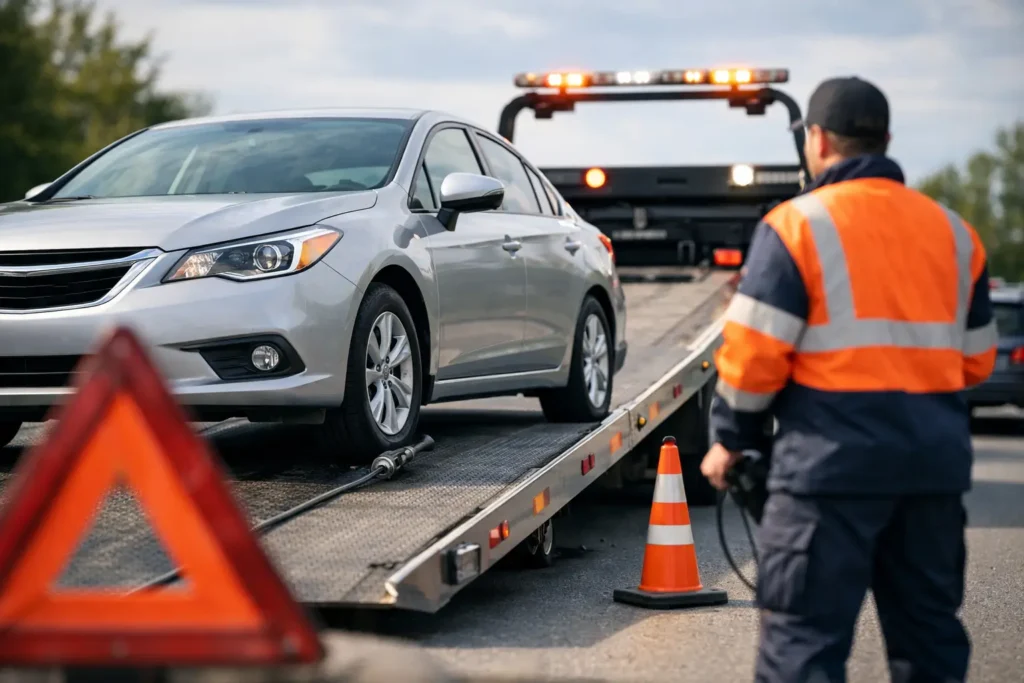
Flatbed towing is often the safest choice because the whole vehicle rides off the ground. It is especially useful for luxury cars, collision-damaged vehicles, motorcycles, EVs, and cars with drivetrain concerns. Wheel-lift towing can be efficient for many standard roadside situations, especially in tighter urban spaces, but it must be used correctly for the specific vehicle.
That is why details matter when you call. A lowered car may need special loading care. An EV may have manufacturer-specific towing requirements. A vehicle with severe front-end damage may need extra handling to avoid scraping or shifting. The fastest truck is not always the right truck.
What emergency towing should cost
Pricing is one of the biggest stress points for stranded drivers, and fair service starts with transparency. The final price can depend on the vehicle type, distance, time of day, location difficulty, and whether special equipment is needed. A simple local tow from a residential street is different from recovery on a highway shoulder or removal from an underground garage.
What matters is whether the pricing is explained clearly before service begins. You should know if there is a base hook-up fee, a mileage charge, after-hours pricing, or additional cost for winching, dollies, or specialty towing. Honest towing companies explain this in plain language.
The cheapest quote is not always the best choice if it leaves out key charges or sends the wrong equipment. In emergency service, a slightly higher but clearly stated price can save time, protect the vehicle, and avoid a much worse bill later.
If you have been in a collision
After an accident, towing decisions carry more weight. If anyone is injured, call emergency services first. If the vehicle is drivable but damaged, do not assume it is safe to continue. Suspension, steering, wheel alignment, and fluid systems may be compromised even when the car looks mostly intact.
Take photos if you can do so safely. Note the location, vehicle positions, visible damage, and any debris. Then focus on getting the vehicle removed without adding to the problem. Collision towing often works best with a flatbed, especially if there is wheel damage, airbag deployment, or unknown underbody impact.
This is also the time to be careful about where the vehicle is being taken. Some drivers want the car moved to a repair shop, while others prefer a home driveway or secure lot until the next step is clear. Confirm the destination before the tow begins.
Special cases: EVs, trucks, and motorcycles
Modern roadside calls are not one-size-fits-all. EV towing deserves extra caution because improper handling can damage the battery system or drivetrain. Some electric vehicles should not be towed with wheels on the ground at all. If you drive an EV, tell dispatch immediately and wait for the correct equipment.
Pickup trucks and work vehicles raise a different issue: weight and cargo. If the truck is loaded with tools, materials, or equipment, the towing provider needs to know. The same goes for commercial vans. Weight changes both safety and truck selection.
Motorcycles also need proper securement. This is not a job for improvised straps and guesswork. The bike should be stabilized, protected from shifting, and transported with equipment meant for two-wheel vehicles.
What to do while waiting for the tow truck
Waiting can feel longer than it is, especially at night or on the side of a busy road. Stay visible, stay aware, and keep your phone charged if possible. If you are in a safe location, gather your license, registration, and insurance details so you are ready when the operator arrives.
If weather is severe, staying warm or cool matters too. Use the vehicle carefully if it is safe to do so, but avoid running an overheating engine or sitting in an unsafe spot just for climate control. On high-speed roads, distance from traffic is usually the priority.
When the truck arrives, confirm the company name, destination, and expected charges before loading starts. A professional operator should walk you through the process and answer your questions without pressure.
Choosing the right towing company fast
In a real roadside emergency, drivers often search while stressed, tired, or late. That is when bad service can slip in. The better approach is to look for a company that is available 24/7, gives direct answers, and clearly handles the type of vehicle and problem you have.
Local coverage matters in a large urban area. A dispatcher who knows Downtown Toronto, Midtown, Etobicoke, Scarborough, North York, East York, Little Italy, and Parkdale can usually move faster than a generic call center with limited area awareness. Fast dispatch is not just about convenience. It reduces your time exposed on the roadside.
It also helps to choose a provider that emphasizes licensed, insured operators and fair pricing. If the company sounds calm, organized, and specific on the phone, that usually carries through to the service itself. Emergency Roadside Service by South Toronto is built around that kind of response – urgent when it needs to be, steady when you need reassurance.
The best towing decision is the safe one
A lot of drivers wait too long before calling because they hope the car will recover, the warning light will clear, or the next mile will somehow be easier. Sometimes that gamble works. Often it makes the situation worse.
Emergency towing is not just about moving a disabled vehicle. It is about protecting you, your passengers, your car, and everyone else on the road. When the problem is serious, quick action is the smart move. Stay calm, get to safety, give clear information, and let the right help do the rest.
If you ever find yourself stranded, remember this: the goal is not to tough it out. The goal is to get home safely.