A tow truck vs flatbed decision can feel like a detail when your car will not start, you have been in a collision, or you are stuck on the side of a busy Toronto road. But the right equipment affects your vehicle’s safety, the condition it arrives in, and how quickly the recovery can happen. The good news is that you do not need to diagnose the towing method alone. A professional dispatcher can match the truck to your vehicle and situation.
When you call for help, share the vehicle type, whether it starts, the condition of the wheels, and whether there was an accident. Those details help the operator arrive prepared instead of losing valuable time at the roadside.
Tow Truck vs Flatbed: The Main Difference
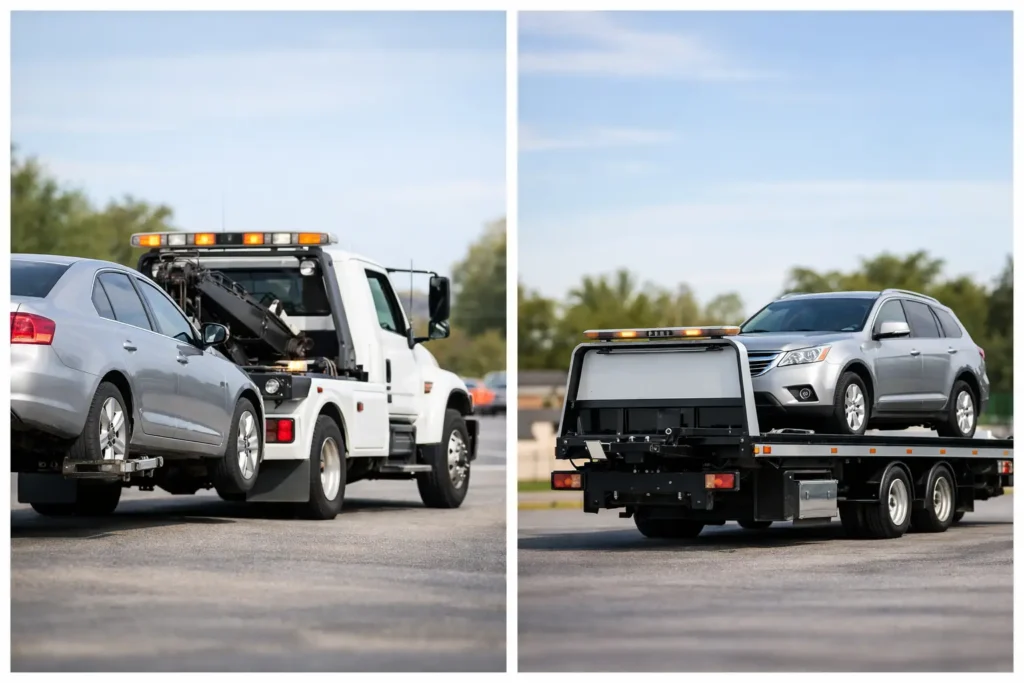
A conventional tow truck usually lifts one end of the vehicle while the other two wheels remain on the road. In most modern operations, this means a wheel-lift truck rather than the old-style hook-and-chain method. The wheel lift supports the tires or frame area securely, then tows the vehicle with either the front or rear wheels rolling.
A flatbed, also called a rollback, carries the entire vehicle on a level platform. The bed tilts and slides down to the pavement, allowing the vehicle to be driven, winched, or carefully loaded onto it. Once loaded, all four wheels are off the ground.
Neither method is automatically better for every call. A wheel-lift tow can be efficient for a straightforward local move, especially when the vehicle is parked in a tight space. A flatbed provides more complete protection and is often the right choice for damaged, all-wheel-drive, low-clearance, luxury, electric, or non-running vehicles.
When a Standard Tow Truck Makes Sense
A wheel-lift tow truck is a practical option when the vehicle is mechanically sound enough for its non-driven wheels to roll and the manufacturer permits that towing setup. It can be the fastest solution for a short-distance tow involving a front-wheel-drive vehicle with the front wheels raised, or a rear-wheel-drive vehicle with the rear wheels raised.
It is also useful in cramped locations. Underground garages, narrow laneways, packed downtown streets, and certain parking lots may not provide enough room for a flatbed to position and load safely. An experienced operator will assess clearance, traffic flow, and access before deciding what can be done without creating another hazard.
For a simple breakdown, such as a failed starter or a vehicle that cannot be driven but has no collision damage, a wheel-lift may be a safe and cost-effective choice. The key issue is not just whether the car can be moved. It is whether moving it that way could harm the drivetrain, bumper, suspension, or wheels.
Drivetrain rules matter
The most important question is which wheels receive power. Towing a front-wheel-drive car with its drive wheels on the ground can damage the transmission. The same concern applies to a rear-wheel-drive vehicle towed with the rear wheels rolling.
All-wheel-drive and four-wheel-drive vehicles require extra care. Many should be carried on a flatbed because all four wheels are connected to the drivetrain. Some models can be towed with dollies or under specific manufacturer instructions, but this is not a situation for guesswork on the shoulder of the road.
When Flatbed Towing Is the Better Choice
Flatbed towing is often the safest option because it keeps the entire vehicle off the pavement. There is no rolling mileage, no need to turn a driveshaft, and less risk of contact with road debris during transport. That makes it the preferred method for many higher-risk situations.
A flatbed is usually recommended after a collision, particularly if a wheel is bent, a tire is flat, steering is damaged, a bumper is hanging loose, or fluids are leaking. Trying to roll a damaged vehicle can worsen the problem or make it unstable during transport. A controlled winch load onto a flatbed protects the vehicle and the people working around it.
It is also the standard choice for electric vehicles. EVs are heavier than many gas-powered cars due to their battery packs, and their drivetrain systems have specific towing requirements. In many cases, the manufacturer directs owners to transport the vehicle with all four wheels off the ground. If an EV has battery damage after a crash, it needs even more cautious handling.
Flatbeds are a strong fit for vehicles with low ground clearance, including sports cars, modified cars, and some luxury vehicles. A skilled operator can use the right loading angle and equipment to reduce the risk of scraping the front bumper, rocker panels, or underbody.
Situations That Usually Call for a Flatbed
If any of the following applies, tell the dispatcher right away so the right truck can be sent:
- Your vehicle is all-wheel drive, four-wheel drive, electric, hybrid, low-clearance, modified, or a high-value vehicle.
- The car has collision damage, a broken wheel, suspension damage, locked wheels, or a flat tire that cannot safely roll.
- The vehicle will not start and cannot be shifted into neutral, or it is stuck in park.
- You need a motorcycle, specialty vehicle, or vehicle with unknown mechanical damage transported.
- You are concerned about avoiding any added mileage or drivetrain movement during the tow.
A flatbed may cost more in some circumstances because of the equipment, loading process, vehicle size, or recovery complexity. Still, the cost of repairing a damaged transmission, underbody, or suspension can be far greater than choosing the correct transport method at the start.
What About Accident Recovery?
After a collision, safety comes before the towing method. Move yourself and passengers away from traffic if it is safe to do so, turn on hazard lights, and contact emergency services if anyone is injured or the scene is dangerous. Do not stand between vehicles or attempt to inspect damage near active traffic lanes.
For accident towing, the operator needs a clear picture of the vehicle’s position and condition. Let dispatch know if the car is blocking a lane, in a ditch, against a curb, in a garage, or unable to roll. Photos can help if you are booking online, but do not put yourself at risk to take them.
A flatbed is common after an accident, but recovery can involve more than loading a car onto a deck. The operator may need to stabilize the vehicle, manage damaged wheels, use skates or dollies, or coordinate with police and traffic conditions. Licensed, insured professionals have the equipment and training to handle those details safely.
How to Get the Right Tow Without Delays
The fastest way to get the right truck is to provide accurate information during the first call. Start with your exact location, including the nearest intersection, highway direction, parking level, or landmark. Then provide the year, make, model, and drivetrain if you know it. Mention whether the vehicle starts, rolls, shifts into neutral, or has visible damage.
Be direct about obstacles. Tell dispatch if you are in an underground garage, have a very low car, are towing a trailer, or have oversized tires. These details are not complications to hide. They are what allow the operator to bring the correct equipment and avoid a second dispatch.
You should also ask for clear pricing before service begins. A trustworthy towing company explains the dispatch or hookup charge, mileage, applicable recovery work, and any circumstances that could change the estimate. If the scene changes after the operator arrives, such as discovering hidden suspension damage, you should be told why a different approach is needed.
Choosing Help During a Roadside Emergency
When you are stranded, do not let the nearest available truck make the decision by default. Ask whether your vehicle should be wheel-lift towed or carried on a flatbed, and explain the condition of the car. A professional provider will give you a clear answer based on the vehicle, the damage, and access at the scene.
Emergency Roadside Service by South Toronto provides 24/7 dispatch for towing, flatbed transport, accident recovery, EV towing, and roadside support across the GTA. The goal is simple: send properly equipped help, communicate clearly, and get you out of a stressful situation without unnecessary delays or surprise charges.
If your vehicle is disabled in traffic, prioritize your safety, share the facts with dispatch, and let the right equipment do its job. The best tow is the one that gets your vehicle where it needs to go without adding a second problem.