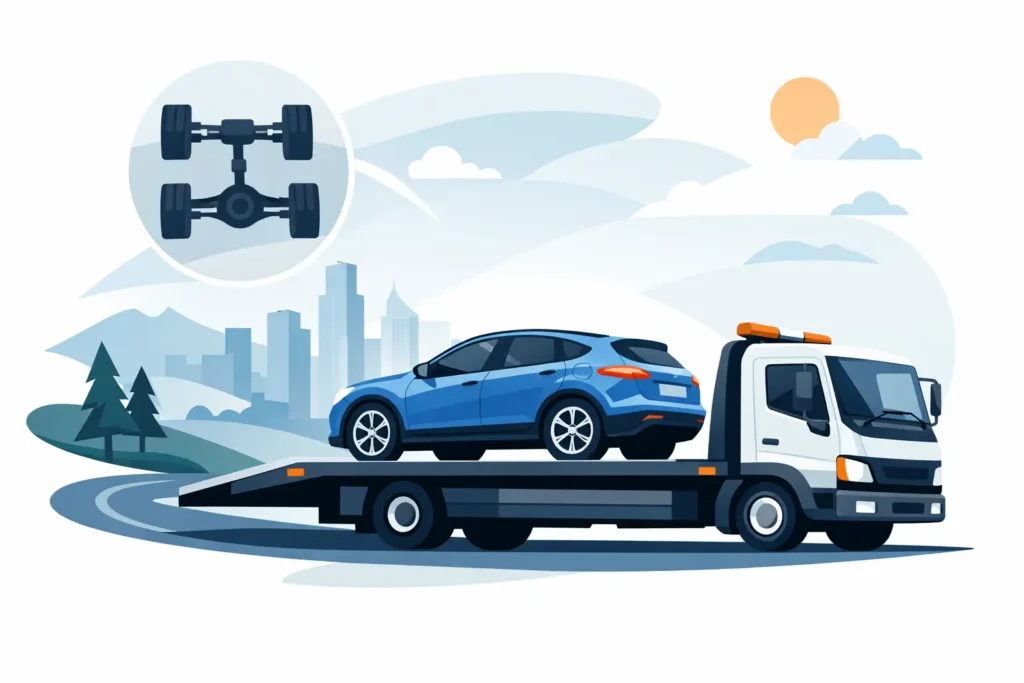
You do not want to learn the hard way that towing the wrong way can damage an all-wheel drive vehicle. If your car breaks down, gets a flat, or is involved in a collision, flatbed towing for all wheel drive vehicles is usually the safest option because it keeps all four wheels off the road and helps protect the drivetrain.
That matters more than most drivers realize. Many AWD systems are always active, and even the ones that shift power automatically can be sensitive when the vehicle is pulled with wheels still on the ground. A quick tow can turn into an expensive repair if the wrong equipment is used. When you are already dealing with a stressful roadside situation, the last thing you need is avoidable transmission or differential damage.
Why flatbed towing for all wheel drive is the safer choice
An all-wheel drive vehicle is designed to send power to all four wheels, either full-time or as needed. That system depends on the front and rear axles, transmission, transfer components, and differentials working together at matched speeds. If two wheels are rolling on the road while the other two are lifted, those parts can be forced to move in ways they were not designed for during towing.
A flatbed solves that problem by loading the entire vehicle onto the truck. None of the tires stay in contact with the road, so the drivetrain stays still during transport. That reduces the risk of mechanical strain and keeps the tow controlled, especially after an accident or when a wheel, suspension part, or tire is damaged.
For many AWD cars, crossovers, and SUVs, this is not just the preferred method. It is the manufacturer-recommended method. There are exceptions in some owner manuals, but they usually involve very specific procedures, short distances, dollies, or special equipment. In an emergency, flatbed service is the clear safe choice.
What can go wrong with the wrong tow
The biggest risk is drivetrain damage. If an AWD vehicle is towed with only two wheels off the ground, the remaining wheels may keep parts of the system turning. Depending on the model, that can overheat or damage the transmission, transfer case, center differential, or other AWD components.
The second issue is hidden damage after a collision. Even if the car looks towable, an accident can bend steering or suspension parts, crack a wheel, or leave a tire unstable. Dragging or partially lifting that vehicle can make the damage worse. A flatbed gives the operator better control and reduces further stress on the car.
There is also the question of clearance. Many newer AWD vehicles sit lower than drivers expect, especially sedans and sport models with long front overhangs. Loading them incorrectly can scrape the bumper, underbody panels, or side skirts. An experienced tow operator will account for approach angle, wheel placement, and securement points before loading.
Not every AWD vehicle is the same
This is where things depend on the make and model. Some vehicles have full-time AWD. Others run primarily in front-wheel drive or rear-wheel drive and only engage additional wheels when traction changes. Some luxury and performance models have highly sensitive systems. EVs with dual-motor setups add another layer of complexity.
That is why a one-size-fits-all answer is risky. The safest move is to treat AWD as a flatbed job unless the manufacturer clearly says otherwise and the towing provider has the right equipment to follow those instructions. In real roadside conditions, especially on a busy street, in bad weather, or after a crash, the safest plan is usually the simplest one.
If you are not sure what drivetrain your car has, do not guess. Tell the dispatcher your vehicle year, make, and model. Mention if it is AWD, 4WD, or electric. That helps send the right truck the first time.
When flatbed towing is especially important
Some situations leave very little room for compromise. If your AWD vehicle has been in an accident, has a damaged wheel, has a flat that cannot be changed safely, or will not shift properly, flatbed towing is the right call. The same goes for vehicles with unknown mechanical issues, warning lights related to the drivetrain, or damage underneath the car.
It is also the better option for long-distance transport. Even if another towing method might work for a very short move under ideal conditions, a flatbed removes the risk of road-induced wear during the trip. For drivers trying to protect a newer vehicle, lease return value, or warranty condition, that peace of mind matters.
In winter, it matters even more. Snow, slush, and ice make loading and towing harder. Toronto drivers know how quickly road conditions can change, and AWD vehicles are common for exactly that reason. But being good in snow does not mean they should be dragged through it during a tow.
What to ask when you call for an AWD tow
When you need help fast, keep the call simple but specific. Say that you need a tow for an all-wheel drive vehicle and ask for a flatbed. Give the exact location, the vehicle details, and a quick description of the problem. If the car was in a collision, mention that right away.
It also helps to say whether the vehicle still rolls, whether the steering works, and whether it is stuck in a garage, tight parking lot, or underground ramp. That information affects truck choice and loading strategy. The more accurate the dispatch details, the faster and safer the response.
A professional company should be able to explain pricing clearly, confirm the type of truck being sent, and give you realistic arrival information. When you are stranded, clarity matters almost as much as speed.
How the flatbed process works
The process is straightforward when handled by trained operators. First, the truck is positioned to create the safest loading angle possible. The bed is tilted down, and the vehicle is either winched or carefully guided onto the platform. Once loaded, the operator secures the car at approved tie-down points so it stays stable without stressing sensitive components.
For disabled AWD vehicles, winching is often the safest method because it avoids forcing the car to move under its own power. If the car has collision damage, locked wheels, or electronic issues, the operator may use skates or specialized tools to load it without dragging it across the pavement.
That attention to detail is what separates a careful tow from a risky one. Fast service is important, but fast and correct is what protects your vehicle.
Why local experience matters in a roadside emergency
A tow in a quiet lot is one thing. A tow on a downtown street, condo garage entrance, highway shoulder, or narrow neighborhood road is another. Drivers in dense urban areas need a company that can dispatch quickly, work safely in traffic, and handle real-world access problems without turning a breakdown into a longer ordeal.
That is where experienced local operators make a difference. A company like Emergency Roadside Service by South Toronto understands the pressure of urgent calls and the need to move quickly without cutting corners. For AWD vehicles, that means sending the right equipment, asking the right questions, and loading the vehicle the safe way from the start.
A few mistakes drivers should avoid
One common mistake is letting price alone decide the tow method. A cheaper tow is not cheaper if it causes drivetrain damage. Another is assuming all towing companies handle AWD vehicles the same way. They do not.
Drivers also sometimes try to move the car themselves when it is making noise, showing drivetrain warnings, or has been damaged in a collision. That can make recovery harder and repairs more expensive. If the vehicle does not feel right, stop driving it and call for proper towing.
Finally, do not assume the tow operator already knows your drivetrain. Say it clearly. “It is all-wheel drive and I need a flatbed” is the kind of detail that prevents mistakes before the truck arrives.
When your car is stranded, the goal is not just getting it moved. It is getting it moved without creating a second problem. Flatbed towing gives AWD vehicles the protection they need, and that is worth asking for every time.