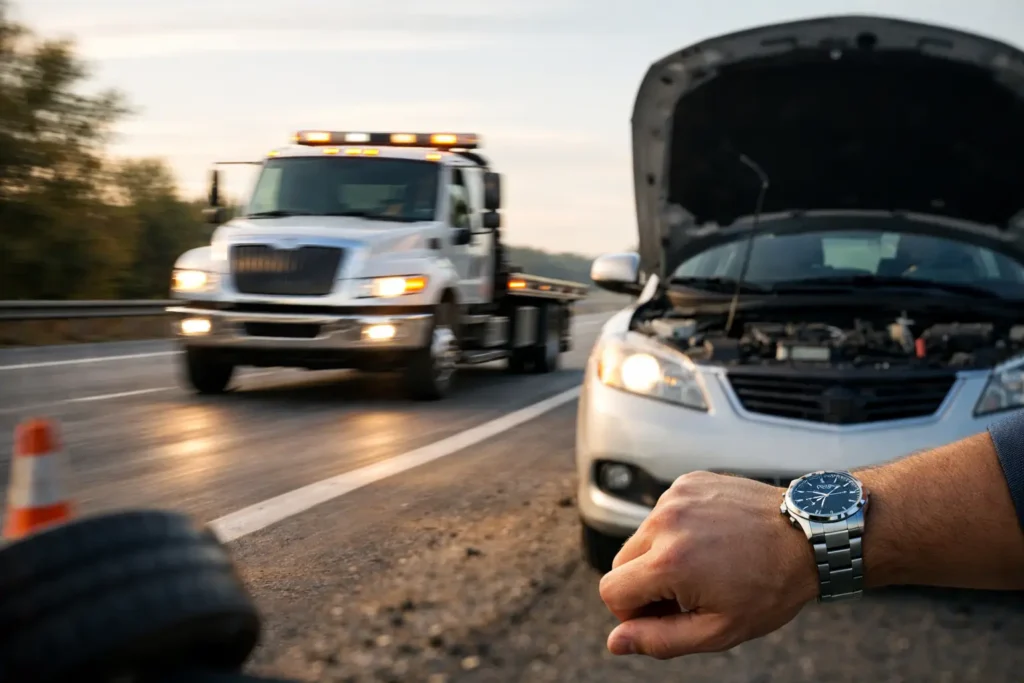
A driver stranded on the Gardiner at night is not asking for a lesson in towing logistics. They want one thing – fast tow truck arrival time they can count on. When your car quits in traffic, your battery dies in a parking garage, or a collision leaves your vehicle unsafe to move, every minute feels longer than it is.
That is why arrival time matters so much in roadside service. It is not just about convenience. It is about safety, traffic exposure, weather, stress, and getting your day back under control. In Toronto and across the GTA, quick dispatch can make the difference between a manageable roadside problem and a much worse situation.
Why fast tow truck arrival time matters
Most people think about towing only when they need it. In that moment, speed becomes personal. If you are blocked in a lane, stuck on a shoulder, parked in an underground garage with a dead battery, or sitting with children in the car during winter, you are not shopping casually. You are trying to solve an urgent problem with as little risk as possible.
A fast tow truck arrival time reduces your exposure to traffic and weather. It also helps limit secondary issues. A simple flat tire can turn into a dangerous roadside wait if the location has poor visibility. A dead battery in a safe lot is one thing. A stalled vehicle near a busy ramp or intersection is another.
Quick response also lowers uncertainty. Most drivers do not know whether the problem needs a jump start, a tire change, a lockout service, fuel delivery, or a full tow. What helps in that moment is knowing a trained operator is on the way and dispatch has your location, vehicle details, and service need under control.
What affects fast tow truck arrival time
There is no honest towing company that can promise the exact same ETA for every call. Traffic, weather, road closures, fleet availability, and the type of vehicle all affect response. A realistic service provider explains this clearly and still works to dispatch the closest qualified truck as fast as possible.
Your location changes everything
A vehicle stopped in a dense downtown corridor may be physically close to a tow operator but harder to reach because of congestion, construction, one-way streets, or restricted access. By contrast, a call in a quieter neighborhood may be farther away on the map but faster to service.
Highways are another variable. An incident on the DVP, 401, or Gardiner may involve traffic backup, lane restrictions, or controlled access that slows approach even when the truck is nearby. Parking structures, condo garages, and loading areas can also add minutes if clearance, entry instructions, or security access are not clear from the start.
The type of service matters
Not every roadside call needs the same equipment. A basic jump start can often be handled quickly by a standard roadside unit. A flatbed tow for a luxury car, EV, or collision-damaged vehicle may require specialized equipment and an operator trained for that job.
That does not mean slower service is careless service. It means the right truck has to be sent the first time. Good dispatch is not just about speed. It is about matching the vehicle and the problem correctly so you do not lose time from a bad first assignment.
Weather and traffic are real factors
Snow, freezing rain, heavy storms, and extreme cold create demand spikes. The same conditions that cause breakdowns and collisions also slow every responding vehicle on the road. Rush hour has a similar effect. A service can still be fast, but even the best dispatch team has to work inside real road conditions.
The key difference is whether the company communicates clearly. Drivers can handle a realistic ETA much better than vague promises. Calm updates matter when you are waiting in a stressful situation.
How dispatch teams keep arrival times fast
Fast response does not happen by accident. It comes from how the service is organized behind the scenes. A reliable roadside company uses active dispatching, local coverage, and a fleet that can handle more than one kind of call across multiple parts of the city.
A strong dispatch team collects the right details quickly: exact location, vehicle type, symptoms, access issues, and whether the situation is dangerous. That may sound simple, but those details prevent delays. If the operator shows up to a low-clearance garage with the wrong equipment, the customer waits longer. If dispatch knows it is an EV that needs flatbed handling, or a commercial vehicle needing a heavier unit, the job starts moving in the right direction immediately.
Local knowledge matters too. A company serving Toronto daily understands bottlenecks, neighborhood access issues, event traffic, and the quickest routes across the GTA. Emergency Roadside Service by South Toronto is built around that kind of urgent dispatch coordination, which is why local focus matters when response time is the priority.
What drivers can do to help speed up arrival
You cannot control traffic, but you can help avoid unnecessary delay. The fastest calls usually start with accurate information. If you need roadside help, give the nearest major intersection, parking level, highway direction, or landmark. If your phone allows location sharing, use it. A vague address can cost valuable time.
Be clear about the problem. If the engine will not start, say whether the lights still work. If you have a flat, mention whether the tire is blown out or simply low. If the car was in a collision, say whether it rolls, whether airbags deployed, and whether it is blocking traffic. If it is an EV, say so immediately.
Keep your phone available after booking. Dispatch may need to confirm your position or ask about vehicle access. Missed calls often create delays that could have been avoided.
Safety comes first while you wait
If you are in a dangerous location, tell dispatch right away. A car stopped in a live lane, on a narrow shoulder, or near a blind curve should be treated differently from a vehicle parked safely in a lot. Turn on your hazard lights. If it is safe to exit the vehicle, move to a secure location away from traffic. If it is not safe to get out, stay buckled inside and wait for instructions.
Fast service matters, but safe waiting matters too. The best roadside support does both – quick dispatch and calm guidance while help is on the way.
What a realistic ETA should sound like
Drivers deserve honesty. A company that promises impossibly short times on every call is usually selling reassurance, not accuracy. Fast tow truck arrival time should mean urgent dispatch, efficient routing, and regular communication, not empty guarantees.
A trustworthy ETA usually sounds specific but conditional. For example, dispatch may say the truck is currently finishing a nearby call, traffic is moderate, and the estimated arrival window is a certain number of minutes. That gives the customer useful expectations without pretending the roads are fully predictable.
There is also a trade-off between sheer speed and proper service. The nearest truck is not always the correct truck. If your vehicle needs flatbed towing, accident recovery, motorcycle transport, or EV-safe handling, the right response may take slightly longer than a generic hookup. In many cases, that extra care prevents damage, confusion, and wasted time afterward.
Choosing a towing company when time matters
When you need help now, the best company is not just the one that says fast. It is the one that can support that claim with 24/7 dispatch, broad coverage, professional operators, and clear communication. Licensed, bonded, and insured service matters because roadside emergencies are high-stress situations. You want speed, but you also want accountability.
Transparent pricing matters too. Drivers under pressure are vulnerable to vague fees, unclear mileage charges, or service upsells they did not expect. A professional company explains the service, provides a clear estimate when possible, and focuses on solving the immediate problem first.
Look for a provider that handles more than towing alone. Sometimes the fastest resolution is not a tow at all. A jump start, fuel delivery, tire change, or lockout service can get you moving again without the delay and cost of transporting the vehicle. Good roadside support starts with the right diagnosis, not the most expensive option.
If you are ever stuck, think in this order: safety, accurate location, clear vehicle details, and immediate dispatch. That is how fast help becomes real help. When the right team answers quickly and sends the right truck without confusion, the wait feels shorter because the problem is finally moving toward a solution.