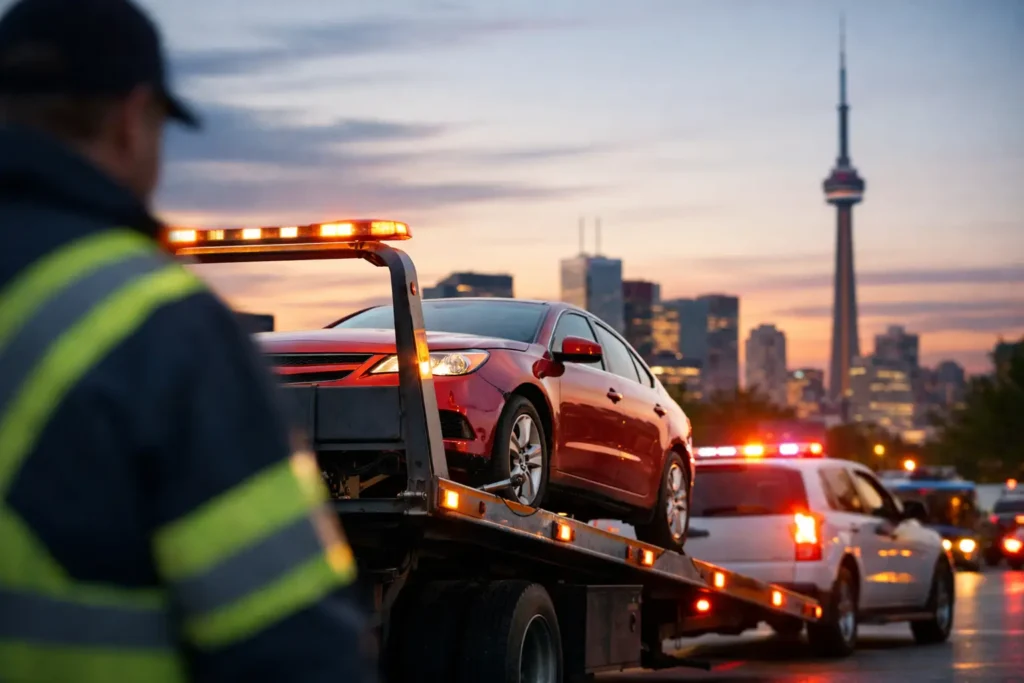
A stalled car on the Gardiner at rush hour feels different than a flat tire in your driveway. One puts you in immediate danger. The other still ruins your day. In both cases, emergency towing Toronto drivers call for should do the same thing fast: protect your safety, send help quickly, and move your vehicle without adding more stress.
When people search for towing in a hurry, they are not looking for a long explanation. They want to know who will answer, how soon a truck can arrive, what it will cost, and whether the operator can handle the vehicle properly. That is what matters in a real roadside emergency, whether you are stuck downtown, in North York, Scarborough, Etobicoke, East York, or anywhere else in the GTA.
What emergency towing in Toronto should actually include
A real emergency towing service is more than a truck with a hook. It starts with dispatch. The call needs to be answered quickly, your location confirmed accurately, and the right equipment sent the first time. If you have been in a collision, drive an EV, need a flatbed, or have a low-clearance vehicle, the wrong truck creates delays you do not have time for.
It also means the operator shows up ready to control the situation, not escalate it. That includes basic traffic awareness, safe loading practices, and clear communication about where the vehicle is going. For many drivers, the best towing experience is the one that feels calm. You are already dealing with enough.
Pricing matters too. During a breakdown, people are vulnerable to vague quotes and surprise charges. A professional towing company should explain the service, give a clear estimate, and tell you if extra factors apply, such as recovery from a ditch, underground parking complications, or a long-distance tow outside the city.
Why fast response matters in Toronto
Toronto traffic changes the equation. A breakdown on a quiet side street is inconvenient. A breakdown on the Don Valley Parkway, Lake Shore Boulevard, or the 401 can become a safety issue within minutes. Even when your vehicle is not badly damaged, where it stops often determines how urgent the tow really is.
Weather makes things harder. Winter battery failures, frozen lockouts, overheated engines in summer congestion, and sudden tire damage from potholes all create situations where waiting is not just frustrating, it can be risky. Families with children, delivery drivers on a deadline, and commercial operators all feel that pressure differently, but the need is the same: get help moving now.
That is why 24/7 availability is not a marketing extra. It is the baseline. Vehicle problems do not respect business hours, and neither should roadside support.
Emergency towing Toronto drivers need most often
Not every urgent call starts with a major accident. Many towing requests begin with a smaller issue that turns into a bigger one because the vehicle cannot be moved safely. A dead battery in the wrong place, a tire blowout on a busy road, or an overheating engine can all lead to an emergency tow.
Collision towing is one of the clearest examples. After an accident, drivers are shaken, traffic is backing up, and there is usually a lot happening at once. In that moment, you want an operator who can recover the vehicle safely and transport it without confusion.
Breakdown towing is just as common. Engines fail, transmissions go, warning lights come on, and vehicles stop without much warning. If the issue can be solved on-site with a jump start, tire change, fuel delivery, or lockout service, that may be the faster option. But if the car is not road-safe, towing is the right call.
There are also vehicle-specific needs. Motorcycles require secure handling. Luxury and low-clearance cars often need flatbed towing. EVs should be moved by operators who understand proper loading points and manufacturer handling requirements. Fast service is important, but proper service matters just as much.
What to do while waiting for the tow truck
The first priority is always safety. If the vehicle can be moved, get it to the shoulder or another safer location. Turn on your hazard lights. If you have reflective markers or flares and it is safe to use them, place them behind the vehicle. If you are on a high-speed roadway or in an exposed lane, stay alert to traffic and follow any police or highway instructions.
If the car cannot be moved, do not stand near traffic to inspect the problem unless it is clearly safe. Many drivers lose time trying to diagnose an issue that will still require towing. A faster move is to contact dispatch, confirm your exact location, describe the vehicle, and mention anything unusual, like a parking garage, collision damage, or a wheel that is locked.
You should also gather the basics before the truck arrives. Know your destination if you already have one in mind, whether that is your home, a repair shop, or a collision center. Keep your phone nearby in case dispatch or the operator needs to confirm directions. If you are upset, cold, or stranded late at night, even simple communication makes the whole process easier.
Choosing the right tow is not one-size-fits-all
The cheapest towing option is not always the right one. In an emergency, speed matters, but so does matching the service to the vehicle and the situation. A standard car tow may work for one breakdown and be completely wrong for another.
Flatbed towing is often the safest choice for all-wheel-drive vehicles, EVs, motorcycles, and damaged cars after a crash. Wheel-lift towing can be efficient in the right scenario, especially for quick urban recoveries, but it depends on vehicle condition and manufacturer guidance. If a car is stuck in a tight underground garage, alley, or awkward parking space, dispatch needs that information before sending equipment.
This is where experienced local operators stand out. Toronto is full of narrow streets, condo ramps, heavy traffic zones, and time-sensitive pickups. The right team understands not just how to tow a vehicle, but how to do it efficiently in the real conditions drivers face every day.
Why local coverage across the GTA matters
A towing company may say it serves Toronto, but response quality depends on actual dispatch reach. A driver stranded in Midtown has different traffic obstacles than someone in Scarborough or Parkdale. Downtown congestion, highway access, and neighborhood density all affect arrival times.
That is why broad GTA coverage matters. It gives dispatch more flexibility to send the closest available unit and reduce unnecessary waiting. For customers, that means less time on the roadside and a better chance of getting the right help on the first call.
It also helps with follow-through. If your vehicle needs to be transported across districts or to a preferred repair destination, a local company with real area knowledge can coordinate that more smoothly than a generic listing service. Emergency Roadside Service by South Toronto is built around that kind of direct, local dispatch support.
What builds trust during an emergency tow
People remember how they were treated when things went wrong. A tow company earns trust by being reachable, direct, and professional from the first call. That means licensed, bonded, and insured operators. It means honest estimates. It means showing up when promised and explaining the process clearly.
It also means not overselling. Sometimes a roadside fix is enough. If a jump start, mobile tire change, lockout service, or fuel delivery will get you moving safely, that may be better than towing. Other times, insisting on a quick roadside fix only delays the real solution. Good service is knowing the difference.
Drivers in stressful situations do not need extra pressure. They need a calm voice, a realistic timeline, and a clear next step. That is what turns a bad day into a manageable one.
When to call now instead of waiting it out
If your vehicle is stopped in traffic, showing signs of serious mechanical failure, leaking fluids, overheating heavily, or damaged after an accident, do not gamble on making it farther down the road. If you feel unsafe where you are parked, or you are stranded late at night with limited options, that is enough reason to call.
The same goes for situations that seem minor but leave the vehicle unusable, like a dead battery in an unsafe location, a flat tire without a spare, or keys locked inside during extreme weather. Waiting rarely improves a roadside emergency in Toronto. Fast action usually does.
The right towing service should make the next step simple: answer fast, dispatch fast, and treat your vehicle and your time with respect. When you are stranded, that is not a luxury. It is the service you should expect.
When your car quits at the worst possible moment, the goal is not just to get a tow. It is to get control of the situation again, safely and without guesswork.