A flat tire can turn a normal drive through Toronto into a safety issue in seconds, especially on the Gardiner, the DVP, busy downtown streets, or a dark residential road. This flat tire roadside guide gives you a clear plan: get out of traffic, protect yourself and your passengers, decide whether a spare is safe to use, and call for professional help when the situation is not right for a roadside change.
First, Get Your Vehicle to a Safer Spot
The moment you feel a tire go flat, do not brake hard or make a sudden turn. Ease off the accelerator, hold the steering wheel firmly, and let the vehicle slow gradually. Turn on your hazard lights as soon as it is safe to do so.
Your first priority is not changing the tire. It is getting away from moving traffic. If the vehicle is still controllable, steer toward a parking lot, wide shoulder, side street, or other flat area with room around the vehicle. Avoid stopping in a live traffic lane, on a narrow shoulder, near a curve, or at the bottom of a hill where other drivers may not see you until the last moment.
If you cannot safely move the vehicle farther, stay calm. Keep the hazards on, keep your seat belt fastened, and assess the traffic around you before opening any door. On a high-speed road or in heavy traffic, calling roadside assistance is usually the safest option. A tire is replaceable. Your safety is not.
Make the Scene Visible Before You Inspect the Tire
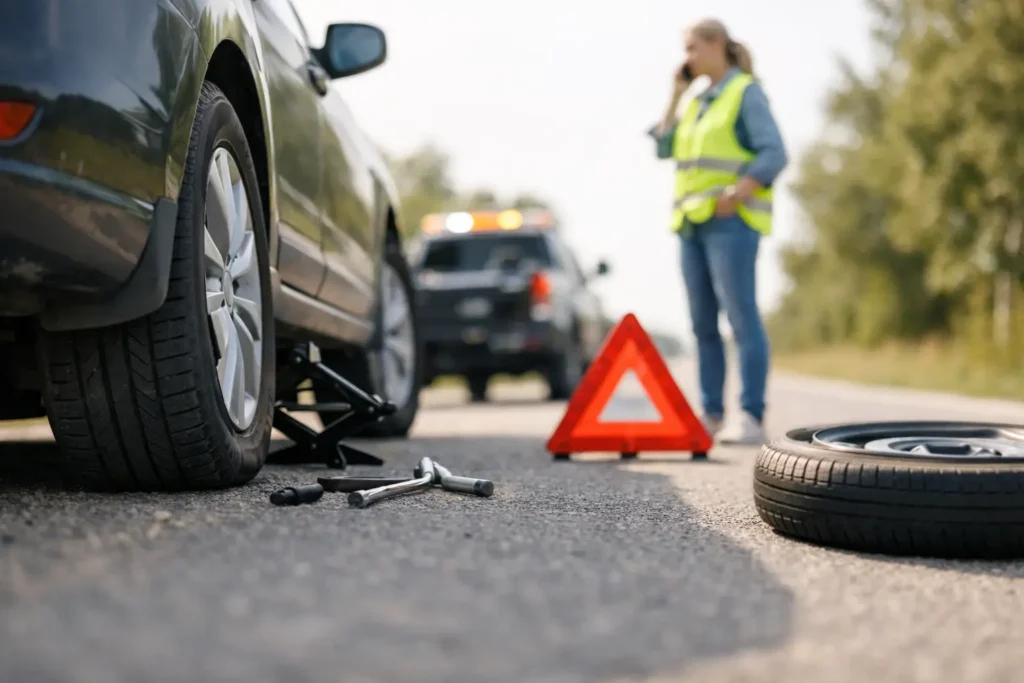
Once you have stopped, shift into park, set the parking brake, and turn the wheels slightly away from traffic if your location allows it. If you have reflective triangles, cones, or flares, place them only when you can do so without stepping into danger. At night, leave interior and exterior lights on as appropriate to make the vehicle easier to see.
Before leaving the vehicle, look for hazards such as fast traffic, icy pavement, poor visibility, a steep slope, or an unsafe shoulder. Families with children should keep everyone inside the vehicle when the roadside is dangerous. The same applies when you are on an expressway, stopped in severe weather, or dealing with an aggressive traffic flow.
A quick visual check may tell you what happened. You might see a nail, screw, sidewall cut, damaged wheel, or tire that has come off the rim. Do not pull out a nail or screw at the roadside. It may be slowing the air loss, and removing it can leave the tire completely flat before help arrives.
Decide Whether a Tire Change Is Safe
Not every flat tire should be changed on the roadside. A spare tire can get you moving again, but only when the location, tools, and vehicle condition support a safe repair.
A roadside tire change may be reasonable if you are on level, solid ground away from traffic; you have a usable spare, jack, and lug wrench; the weather is stable; and you are comfortable following your vehicle manual. Even then, take your time. Rushing with a jack near moving traffic creates unnecessary risk.
Call for help instead if the shoulder is narrow, the vehicle is on an incline, traffic is close, the tire is severely damaged, or you do not have the right equipment. It is also smart to request professional assistance if you drive an EV, a commercial vehicle, a truck with larger wheels, or a vehicle with wheel locks you cannot remove. Some vehicles have specific lift points, tire-pressure requirements, or mobility kits that should be handled correctly.
A damaged sidewall, bent rim, shredded tire, or repeated air loss may mean a spare alone will not solve the problem. In that case, mobile tire service or towing to a repair facility can prevent further damage to the wheel, suspension, or vehicle body.
How to Change a Flat Tire Safely
If conditions are safe and you have confirmed that your spare is in good condition, begin by taking out the jack, lug wrench, and spare. Your owner’s manual is the best source for the correct jack points and torque instructions. Using the wrong lifting point can damage the vehicle or make it unstable.
Loosen the lug nuts while the flat tire is still on the ground. Turn them counterclockwise, but do not remove them yet. Place the jack at the approved lift point, then raise the vehicle only high enough for the tire to clear the ground. Never put any part of your body under a vehicle supported only by a jack.
Remove the lug nuts, take off the flat tire, and line up the spare with the wheel studs. Thread the lug nuts by hand first to avoid cross-threading. Tighten them in a star pattern, lower the vehicle slowly, then tighten the nuts again in the same pattern. Do not rely on guesswork if your manufacturer provides a specific torque requirement.
Afterward, check the spare’s pressure if you have a gauge. A compact temporary spare is not designed for long trips, high speeds, or heavy loads. Many are limited to about 50 mph and should be replaced with a full-size tire as soon as possible. Read the label on the spare and avoid treating it like a permanent solution.
When a Tire Repair Kit Is Not Enough
Many newer vehicles do not carry a traditional spare. Instead, they may include a sealant-and-inflator kit. These kits can sometimes help with a small puncture in the tread area, but they cannot repair a sidewall cut, blowout, damaged rim, or tire that has separated from the wheel.
Sealant also has trade-offs. It may complicate a later tire repair, and some tire pressure monitoring systems can be affected by it. If you are unsure whether the puncture qualifies, do not gamble on a temporary fix in unsafe conditions. A trained roadside technician can assess the tire and help you choose the next safe step.
What to Tell Roadside Assistance
Fast dispatch starts with accurate information. When you call, provide your exact location, including the nearest intersection, highway direction, exit number, landmark, or parking garage level. Share the make, model, and color of your vehicle, the tire location, and whether you have a spare available.
Also mention anything that affects the service call: a locked wheel nut, damaged rim, low-clearance vehicle, EV, cargo load, children in the vehicle, or an unsafe roadside location. This helps dispatch send the right operator and equipment the first time.
Emergency Roadside Service by South Toronto provides 24/7 support for drivers who need a mobile tire change, a safe tow, or clear guidance during a roadside emergency. Licensed, insured assistance matters when conditions are difficult and you need the job handled without added stress.
Prevent the Next Flat Before It Starts
Most flats are not completely predictable, but regular tire checks reduce your odds of being stranded. Check tire pressure at least monthly and before longer drives, using the pressure listed on the driver’s door placard rather than the number molded into the tire sidewall. Inspect tread for nails, cracks, bulges, and uneven wear.
Keep your spare inflated and make sure you know where the jack, lug wrench, locking-wheel-nut key, and wheel-lock adapter are stored. If your vehicle uses a tire repair kit, check its expiration date. A small flashlight, gloves, reflective vest, and portable tire inflator can also make an unexpected stop easier to manage.
When the road is busy, dark, or unpredictable, choosing professional help is the smart call. Get to a safer position, stay visible, and let a qualified roadside operator handle the tire so you can get back on the road with confidence.