You do not want to learn about EV towing while sitting on the shoulder with hazard lights flashing. When drivers ask, is towing safe for electric vehicles, the honest answer is yes – but only when the vehicle is moved the right way. Use the wrong method, and a simple breakdown can turn into expensive drivetrain or battery damage.
That is why EV towing is not just regular towing with a different badge on the trunk. Electric vehicles have high-voltage systems, different weight distribution, and drivetrains that often should not have the drive wheels rolling on the ground while the vehicle is off. If your EV breaks down, gets a flat, will not shift into neutral, or has been in a collision, the safest move is to treat it as a specialized tow from the start.
Is towing safe for electric vehicles in real-world situations?
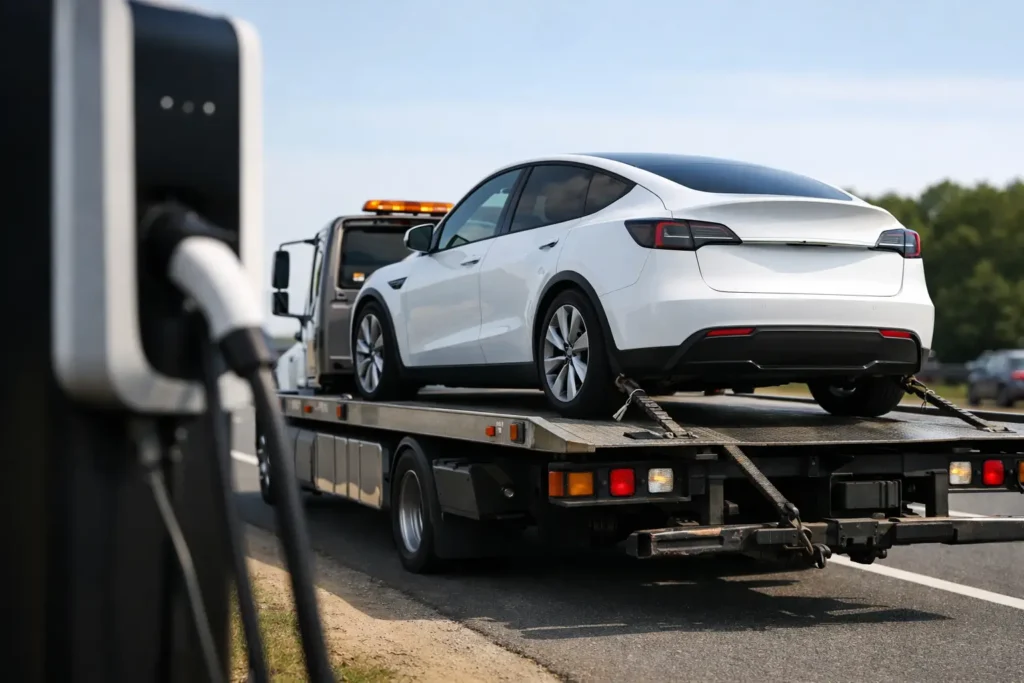
Most of the time, yes. Towing an electric vehicle is safe when the tow method matches the manufacturer’s instructions and the truck operator knows how EVs need to be handled. In many cases, that means a flatbed tow is the safest option because it keeps all four wheels off the road and reduces the chance of motor, transmission, or regenerative braking system damage.
The trouble starts when people assume an EV can be towed like a gas-powered sedan. Some electric vehicles cannot be pulled with two wheels on the ground at all. Others have very specific procedures for transport mode, neutral release, or wheel dollies. There is no one-rule-fits-all answer, which is why the safest approach is always vehicle-specific handling.
For drivers, the key point is simple: the towing itself is not the danger. Incorrect towing is.
Why EVs need different towing procedures
Electric vehicles are built differently from traditional vehicles in ways that matter during roadside recovery. The electric motor is directly tied into how the wheels rotate, and on some models, spinning the wheels while the system is off can create internal damage. That risk is higher if the vehicle is dragged, lifted improperly, or pulled with the drive axle on the road.
Battery placement also changes things. EV battery packs are usually mounted low in the chassis, which helps handling but means ground clearance and lifting points matter more. A careless hookup can damage underbody shielding or battery-related components.
Then there is the issue of weight. EVs are often heavier than similar gas models because of the battery pack. That affects loading angles, winching technique, tie-down strategy, and the type of equipment needed to move the vehicle safely. An operator who handles electric vehicles regularly will account for that. An inexperienced one may not.
When flatbed towing is usually the safest choice
If you remember one thing, remember this: flatbed towing is usually the safest answer for an electric vehicle.
A flatbed keeps the vehicle fully off the ground, which avoids the wheel-rotation issues that can damage certain EV drivetrains. It also gives the operator more control during loading, especially if the car is disabled, stuck in park, or has suspension damage after an accident.
This matters even more for all-wheel-drive EVs and higher-end electric models with complex motor setups. With those vehicles, guessing is a bad idea. A flatbed reduces risk and removes most of the uncertainty.
That does not mean every tow absolutely must be on a flatbed in every situation. Some vehicles can be moved short distances with dollies or manufacturer-approved procedures. But if the goal is maximum safety with minimum risk, flatbed towing is the standard most drivers should ask for.
When towing an EV can become risky
The biggest risk is using the wrong towing method. A wheel-lift tow can be a problem if the wrong wheels remain on the road. Dragging an EV out of a tight space without proper dollies can also lead to drivetrain damage or tire and suspension issues.
Risk goes up after a collision. If the battery pack or high-voltage system may be compromised, the vehicle needs extra caution during recovery and transport. In some crash situations, the concern is not just mechanical damage. Thermal events, though uncommon, are taken seriously with EVs, and trained operators know how to respond.
Another common issue is trying to force the vehicle into neutral. Some EVs have electronic systems that prevent easy movement after a power failure. Improvising can make the situation worse. If the car will not shift, it needs the right recovery setup, not guesswork.
Water exposure creates another layer of concern. If an EV has been through deep flooding, do not attempt to start it or move it casually. It should be assessed and transported carefully, especially if electrical components may have been affected.
What drivers should do before an EV tow
First, move to a safe location if you can do so without driving a damaged vehicle. If the car displays serious warnings, loses power suddenly, or has been in a collision, pull over and stop. Do not keep trying to drive it to “make it home.” That decision can turn a recoverable issue into a major repair.
Next, check your owner’s manual if it is available. Many EV manufacturers give clear instructions about whether the vehicle can be rolled, how to access neutral, and what tow method is approved. If you cannot check the manual, tell the dispatcher your make and model and let them know it is an electric vehicle right away.
It also helps to mention any specific problem, such as a dead 12-volt battery, collision damage, locked wheels, or the vehicle being stuck in a garage. Those details affect what truck and equipment should be dispatched.
If there is any sign of smoke, heat, fluid leak, underbody damage, or impact near the battery area, say that immediately. That is not the time for a basic hookup and fast pull. It is a situation that needs careful handling.
Questions to ask before your EV is towed
If you need a tow for an electric vehicle, ask whether the company has EV towing experience and whether a flatbed is available. Ask if the operator can handle a vehicle that may not shift into neutral. If the EV was in an accident, ask whether they are prepared for high-voltage safety concerns.
These are not technical questions for the sake of sounding informed. They directly affect whether your vehicle is moved safely.
A professional dispatch team should not hesitate when you say you have an EV. They should ask the right follow-up questions, explain the likely tow method, and send equipment that matches the situation. That is part of what separates a real roadside service from a random listing.
Is towing safe for electric vehicles after a breakdown, flat tire, or dead battery?
Usually, yes – as long as the response matches the issue.
For a flat tire, towing may not even be necessary if mobile tire service is available and the wheel can be changed safely on-site. For a dead 12-volt battery, some EVs can be jump-started at the low-voltage system to restore access and controls, but that should be done correctly. The main traction battery is a different matter and should never be treated like a standard battery problem.
For mechanical faults, charging failures, software lockups, or drivetrain warnings, towing is often the safest choice because continuing to drive may cause more damage or leave you stranded in a worse spot. In those moments, speed matters, but proper handling matters more.
For drivers across Toronto and the GTA, this is where a service like Emergency Roadside Service by South Toronto becomes valuable. Fast dispatch is important, but fast dispatch with the right truck and trained operator is what actually protects the vehicle.
The bottom line for EV owners
Electric vehicles can be towed safely every day. The catch is that they need the correct method, proper equipment, and an operator who understands what not to do. Flatbed towing is usually the safest route, especially when the vehicle is disabled, damaged, or the manufacturer procedure is unclear.
If your EV breaks down, do not let urgency push you into the wrong recovery choice. Tell the dispatcher it is an electric vehicle, describe the problem clearly, and ask for a tow setup that protects the drivetrain and battery system. A few extra seconds on that call can save you from a much bigger repair bill later.
When something goes wrong at the roadside, the safest plan is not the fastest guess. It is the right recovery, done carefully, by people who know exactly how to move your vehicle without adding to the problem.