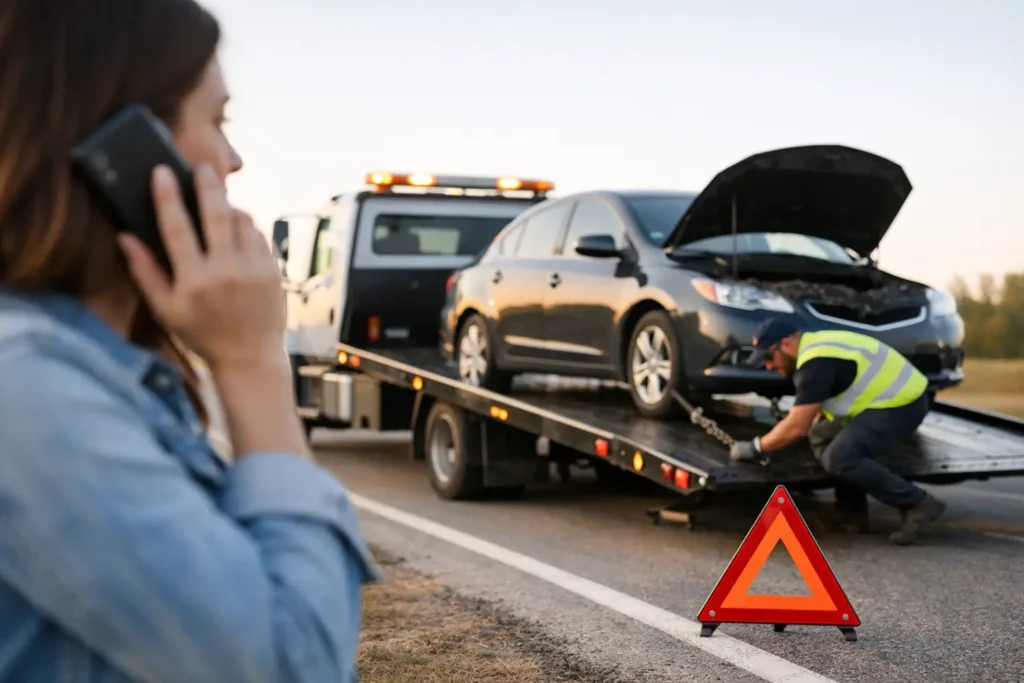
You usually realize you need a tow truck at the worst possible moment – on the shoulder in heavy traffic, in a dark parking lot, after a fender bender, or when your car simply refuses to move. If you are wondering how to call a tow truck, the goal is not just to get help fast. It is to get the right help, from the right operator, without wasting time or putting yourself in more danger.
A lot of drivers make the same mistake in a breakdown. They focus only on finding any towing company, then sort out the details later. That can lead to delays, the wrong truck being sent, confusion about pricing, or extra stress when you already have enough to deal with. A better approach is simple, calm, and specific.
How to call a tow truck when you are stranded
Start with safety before you make the call. If your vehicle can still roll, move it to a safe location away from traffic if possible. Turn on your hazard lights right away. If you are on a busy road, stay inside the vehicle with your seatbelt on unless remaining inside is unsafe. If you are in a parking lot or residential street, step out only if the area is secure and well lit.
Once you are safe, call a towing company directly. A live dispatcher is usually the fastest route when you need urgent roadside support. Be ready to speak clearly and give short, useful information first. The dispatcher needs to know where you are, what happened, what kind of vehicle you have, and whether the vehicle is drivable.
If you are in the GTA and need immediate service, companies such as Emergency Roadside Service by South Toronto are built around dispatch speed, 24/7 availability, and getting the right truck out on the first attempt. That matters more than most drivers realize. A flatbed, wheel-lift, battery service vehicle, or lockout technician may all be different dispatches depending on your situation.
What to say when you call
The fastest calls are the clearest ones. When you call, start with your exact location. Do not just say a neighborhood or major street if you can avoid it. Give the street name, nearest intersection, highway direction, exit number, parking lot name, or visible landmark. If your phone allows it, check your map app for the precise location before you speak.
Next, explain the issue in one sentence. Say something like, “My car will not start,” “I was in a minor accident and need a tow,” “I have a flat tire and no spare,” or “My EV needs flatbed towing.” This helps dispatch determine whether you need a tow truck or another roadside service.
Then give vehicle details. The make, model, color, and whether it is front-wheel drive, all-wheel drive, lowered, oversized, or electric can affect the truck required. If the car is stuck in a garage, blocked in a tight lot, or has wheel damage after a collision, say that too. Small details can change the equipment needed.
Finally, ask the practical questions that matter. Confirm the estimated arrival time, expected price or pricing structure, payment methods, and where the vehicle can be taken. A professional dispatcher should be able to explain this without making it complicated.
The details that speed up dispatch
When drivers panic, they often leave out the one detail that causes the delay. It is usually location, access, or vehicle condition.
If you are on a highway, say which side you are on and which direction you are traveling. “Highway 401 eastbound near Avenue Road” is much more useful than “on the 401.” If you are underground or in a condo garage, mention height restrictions. If you were in a collision and the wheels are damaged, say the vehicle may not roll freely. If your steering is locked or a tire came off the rim, mention that immediately.
These details help dispatch send the right operator and avoid a second truck or a longer wait. In towing, accuracy is speed.
When you may not need a tow truck
Not every roadside problem needs towing. Sometimes a driver searches how to call a tow truck when the faster, less expensive option is roadside assistance.
If the battery is dead, you may only need a jump start. If you locked your keys in the car, a lockout service is the right call. If you ran out of gas, fuel delivery can get you moving again. A flat tire may be handled by a mobile tire change if you have a usable spare. Even some no-start issues are not towing problems at first.
That said, it depends on the situation. A flat tire on a safe driveway is different from a shredded tire on the shoulder of a freeway at night. A dead battery in winter can turn into a repeat failure if the alternator is bad. If you are unsure, tell dispatch exactly what is happening and let them guide you to the proper service.
What a tow truck company will ask you
Most calls follow a simple pattern. The dispatcher will usually ask for your location, the reason for service, your vehicle information, your destination, and your contact number. They may also ask whether anyone is injured, whether police are on scene, or whether the vehicle is blocking traffic.
Answer directly and do not guess if you are unsure. If you do not know your exact mechanical problem, say what the vehicle is doing instead. For example, “It clicks but does not start” is better than trying to diagnose the battery yourself. “The front wheel is bent inward after hitting a curb” is more useful than “I think the suspension is broken.”
How much information about price you should get
You do not need a complicated quote while sitting on the roadside, but you should get basic clarity. Ask whether there is a hook-up fee, mileage fee, after-hours charge, or added cost for special equipment. If the tow is local, ask for the estimated total. If the situation is more complex, ask how pricing is calculated.
Transparent pricing matters because towing is often urgent. You may not have time to compare multiple providers while traffic is moving past your door. A professional company should be able to give a fair estimate and explain any variables without sounding evasive.
What to do while waiting for the tow truck
After the call, keep your phone close and stay available in case dispatch or the driver needs to confirm your position. If it is safe, gather your license, registration, and anything valuable you may need from the car. Take photos of the vehicle if there was an accident or visible damage before loading.
If you are on a high-speed road, do not stand outside next to the vehicle unless emergency personnel instruct you otherwise. Passing traffic is the real danger in many breakdown situations. If you are in a safer spot, keep an eye out for the truck and verify the company name before handing over your keys.
You should also know where the vehicle is going before it leaves. That could be your home, a repair shop, a body shop, or a dealership. If you have not decided, say so during the call and ask about your options.
Common mistakes drivers make
The biggest mistake is calling before getting to a safe position. The second is giving vague information. The third is assuming every disabled vehicle needs the same type of tow.
Another common issue is forgetting to mention special vehicle requirements. Electric vehicles, motorcycles, luxury cars, lowered vehicles, and all-wheel-drive vehicles may require specific handling. Sending a standard tow setup for a car that needs a flatbed can slow everything down and create unnecessary risk.
Drivers also sometimes focus only on arrival time and forget to ask where the car can be taken or what the estimated cost will be. Fast service matters, but so does knowing what happens next.
A simple script if you are stressed
If your mind goes blank, keep it short: “I need roadside help. My location is [exact location]. My vehicle is a [year, make, model]. The problem is [brief issue]. The vehicle is [drivable or not drivable]. I need it to go to [destination if known]. What is your ETA and estimated price?”
That one script covers nearly everything dispatch needs to begin helping you.
Breakdowns are stressful, but the call itself does not need to be. Stay safe, give clear details, and work with a towing company that treats urgency, pricing, and professionalism seriously. A calm, accurate phone call is often the fastest way to turn a bad roadside moment into a solved problem.