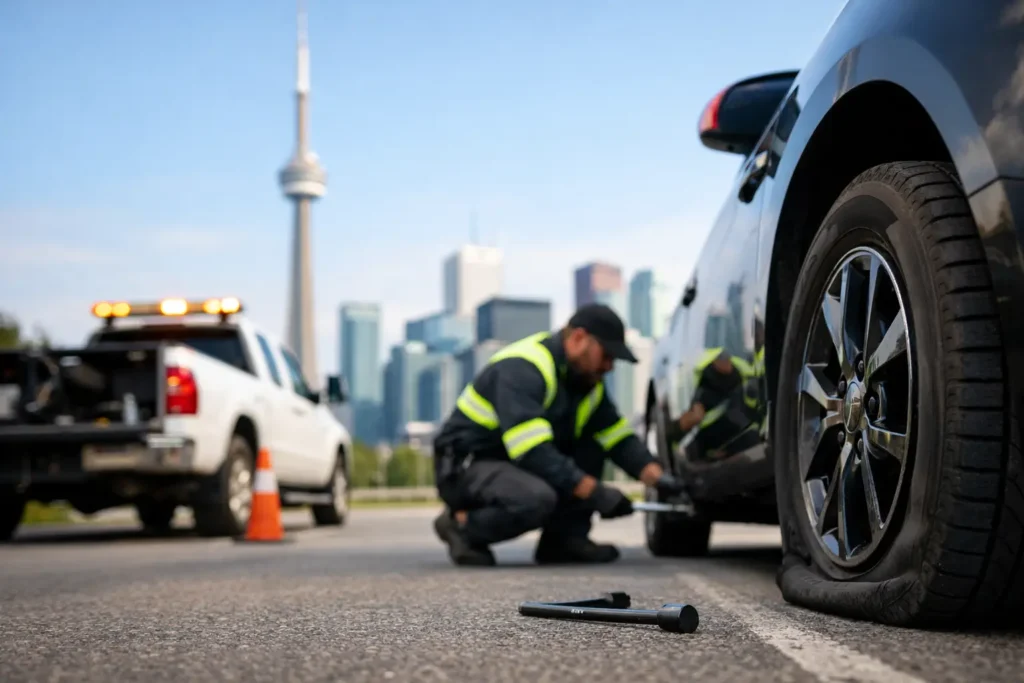
A flat on the Gardiner at night feels different than a flat in your driveway. Traffic is moving fast, your hazards are on, and every minute makes the situation feel bigger. If you need flat tire roadside Toronto service, the first priority is not speed with a lug wrench – it is safety, clear communication, and getting help dispatched fast.
In Toronto, tire trouble rarely happens at a convenient time. It hits during the morning commute in North York, after a grocery run in Etobicoke, outside an apartment building in Midtown, or while making deliveries through Downtown. Some drivers have a spare and the tools but not a safe place to work. Others have a damaged rim, a seized lug nut, or no usable spare at all. That is why roadside tire service matters. The goal is simple: get you out of danger, get the tire handled properly, and get you moving again without adding more stress.
When flat tire roadside Toronto service is the right call
There is a difference between a minor inconvenience and a roadside risk. If your vehicle is stopped on a shoulder, near a live lane, in poor weather, in low visibility, or in an unfamiliar area, calling for roadside assistance is usually the safer move. The same applies if you are driving a larger SUV, a work van, or a vehicle with wheel locks you have not used in years.
A lot of drivers assume a flat tire should always be a quick do-it-yourself fix. Sometimes it is. But in real roadside conditions, things get complicated fast. Lug nuts can be overtightened. Jacks can slip on uneven ground. Spare tires can be underinflated or missing entirely. Newer vehicles may not even come with a full spare, and some run-flat tires still need professional assessment after damage.
If the tire blew out after hitting a pothole, curb, or debris, there may be more going on than the rubber. Bent rims, suspension damage, or sidewall failure can make a simple tire swap the wrong answer. In those cases, a trained roadside operator can tell whether a mobile tire change is enough or whether towing is the safer next step.
What to do first when you get a flat in Toronto
The best decisions happen in the first two minutes. Ease off the gas, hold the wheel steady, and avoid slamming the brakes unless traffic conditions leave no choice. If the vehicle is still drivable, move as far from traffic as possible. A parking lot, side street, wide shoulder, or safe curb lane is better than stopping in a live lane.
Turn on your hazard lights right away. If you have reflective triangles or road flares, use them only if you can place them without stepping into danger. If you are on a highway shoulder or in fast-moving traffic, stay inside the vehicle with your seatbelt on unless there is an immediate hazard like smoke or fire. Standing next to the car on a busy roadway is often riskier than waiting inside it.
Then call for help with your exact location. Major intersections, highway direction, exit numbers, parking garage levels, and nearby landmarks all speed up dispatch. If you know the tire position – front driver side, rear passenger side, and so on – mention that too. Clear details help the operator send the right support and avoid delays.
Why roadside tire changes are not always straightforward
On paper, changing a tire sounds simple. Loosen the nuts, lift the vehicle, swap the wheel, tighten everything down. On the roadside, the conditions are rarely ideal.
Toronto streets bring snow, slush, rain, potholes, streetcar tracks, narrow parking lanes, and heavy traffic. Even in good weather, the surface may be tilted or unstable. That matters because a jack needs solid footing, and a vehicle that shifts while lifted creates a real safety issue.
There is also the question of what tire is going on the car. A compact spare is only a temporary solution and comes with speed and distance limits. A damaged spare does not solve anything. If the flat tire was caused by impact damage, the spare may get you rolling, but it does not address a cracked rim or alignment issue. Good roadside service is not just about swapping rubber. It is about making the right call for what comes next.
What a professional flat tire roadside response should include
When you call for service, you should expect more than a vague arrival window. A dependable roadside company should provide prompt dispatch, clear communication, and honest pricing before the work begins. That matters when you are stranded and trying to make a quick decision.
Professional operators also come prepared for more than one outcome. If your spare is usable, a mobile tire change may be enough. If the wheel is damaged, the lug nuts are locked, or the vehicle cannot be safely serviced where it sits, towing may be necessary. A proper roadside response adjusts to the situation instead of forcing a one-size-fits-all fix.
You should also expect care with the vehicle itself. Modern cars, EVs, trucks, and luxury vehicles all have different lift points and handling requirements. The wrong jack position can do damage. So can rushing the job in poor conditions. Licensed, bonded, and insured service gives drivers another layer of protection when the situation is already stressful.
Flat tire roadside Toronto for downtown, midtown, and the GTA
Location changes the job. In Downtown Toronto, access is often the issue. Condo ramps, underground garages, one-way streets, and dense traffic can slow down anyone who is not used to the area. In Midtown, side streets and curbside parking create tight working spaces. In Scarborough and Etobicoke, longer corridors and faster roads can turn a flat into a bigger safety concern. On highways and major routes, traffic exposure becomes the top issue.
That is why local dispatch matters. A team that understands Toronto neighborhoods can route operators faster, ask the right questions, and avoid common access problems. For drivers, that means less waiting and fewer frustrating back-and-forth calls while you are stuck on the side of the road.
Emergency Roadside Service by South Toronto is built around that kind of response – fast dispatch, 24/7 availability, and practical roadside support across Toronto and surrounding areas when drivers need help now.
How to know if you need a tire change or a tow
It depends on the condition of the vehicle and where it is stopped. If you have one damaged tire, a safe stopping location, and a good spare, a roadside tire change is often the fastest option. If the tire came apart at highway speed, the rim is bent, the wheel well is damaged, or more than one tire is affected, towing is usually the better call.
The same goes for vehicles without a spare, vehicles loaded with cargo, and situations where the car is stuck in an unsafe position. Trying to force a tire change in the wrong conditions can waste time and increase risk. A good dispatcher will ask enough questions to guide you toward the safer option, not just the cheapest one in the moment.
What drivers can do to avoid the next flat
No one avoids every tire problem in Toronto, but a few habits lower the odds. Check tire pressure regularly, especially when temperatures swing. Look for uneven wear, sidewall bulges, and nails before a long drive. Replace worn tires before rain or snow season, not after the first bad day on the road.
It also helps to know what your vehicle actually carries. Many drivers assume they have a spare, jack, and key for wheel locks, then find out otherwise when they need them most. A quick check at home is easier than learning on the shoulder of the Don Valley Parkway.
If you drive for work, the stakes are higher. Delivery schedules, service calls, and passenger pickups all depend on uptime. In that case, roadside support is not just a convenience. It is part of keeping your day and your income on track.
A flat tire can throw off your plans in seconds, but it does not have to turn into a bigger roadside emergency. The right response is fast, calm, and focused on safety first. If you are stuck, get to a safer position if you can, turn on your hazards, and call for help that gets you moving again without guessing.