A tire touches a soft shoulder, the steering wheel pulls, and suddenly your vehicle is angled in a ditch, snowbank, median, or muddy roadside. Vehicle recovery after a slide off road can become dangerous fast when drivers try to power out, stand near traffic, or accept a tow from equipment that is not suited to the job. The safest move is to stop, protect yourself and your passengers, and arrange professional recovery.
For drivers across Toronto and the GTA, a slide-off can happen in minutes during freezing rain, slush, heavy snow, standing water, or even on a dry-looking shoulder after dark. A calm response helps prevent a minor roadside incident from becoming vehicle damage, an injury, or a secondary collision.
What to Do Immediately After Sliding Off the Road
Once the vehicle stops moving, take a breath and assess the scene before doing anything else. If you are injured, if the vehicle is blocking active lanes, or if there is a fire, fuel leak, downed power line, or immediate traffic danger, call 911. Do not approach a downed wire or touch the vehicle if one is nearby.
If the vehicle is stable and you can remain safely inside, stay buckled up with the doors locked. Turn on hazard lights. At night or in poor visibility, interior lights can also make the vehicle easier for responders to see, although you should avoid draining a weak battery unnecessarily.
Getting out is not always safer. On a high-speed road, a blind curve, or an icy shoulder, people outside the vehicle are extremely vulnerable. Exit only if the vehicle itself is unsafe to occupy and you have a clear path away from traffic. Move well beyond the roadway and stay uphill from the vehicle if it has gone into a ditch or embankment.
Call for recovery assistance and provide the dispatcher with your exact location, travel direction, nearby intersections, highway markers, and a clear description of where the vehicle sits. Mention whether it is in snow, mud, water, a ditch, against a guardrail, or on a slope. Also identify the vehicle type, especially if it is an EV, all-wheel drive, a truck, or a vehicle with low ground clearance.
Why Vehicle Recovery After a Slide Off Road Needs the Right Equipment
A slide-off is not always a standard tow. The recovery operator must consider traction, vehicle weight, the angle of the vehicle, the condition of the ground, traffic exposure, and where a recovery truck can safely set up. Pulling from the wrong point or at the wrong angle can damage a bumper, suspension component, wheel, underbody panel, or drivetrain.
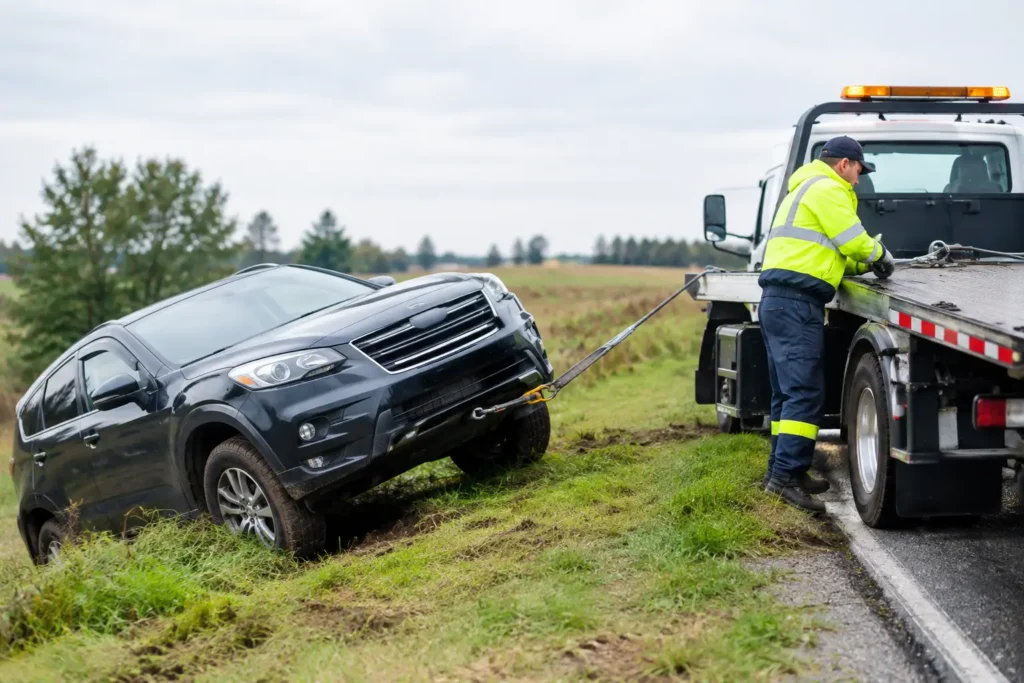
A trained operator may use a winch, recovery straps, wheel-lift equipment, a flatbed, or a combination of methods. The right choice depends on the scene. A vehicle sitting level on a firm shoulder may need a straightforward winch-out. One resting in deep snow or mud may require a more controlled extraction. If a vehicle has come to rest at an angle near a ditch, the operator may need to stabilize it before moving it.
Flatbed towing is often the best follow-up option when the vehicle may have hidden damage or when it cannot be safely driven. This is particularly relevant for many electric vehicles, performance cars, all-wheel-drive vehicles, and vehicles with damaged tires, steering, or suspension. A quick pull to the pavement is not the same as confirming the vehicle is roadworthy.
Do Not Try to Drive Out Blindly
It is tempting to shift between drive and reverse, spin the tires, and try to gain momentum. That approach can make recovery harder. Spinning tires dig deeper into snow, mud, or loose gravel. It can also overheat components, damage tires, and spray debris toward people standing nearby.
Avoid attaching a rope, chain, or strap to another vehicle unless a qualified professional directs the recovery. Consumer tow straps can fail under load, and improvised attachment points can break loose. A snapped strap or chain can cause serious injury. Never stand over, beside, or in line with a tensioned recovery strap.
Do not place branches, floor mats, cardboard, or loose objects under the tires when traffic is close or the ground is unstable. These tactics may work in a low-risk parking lot situation, but they are not a safe answer beside moving traffic, on an icy slope, or when the vehicle is partially in a ditch.
Information That Speeds Up Dispatch
A recovery crew can arrive prepared when the dispatcher has accurate details. Tell them whether anyone is hurt, whether police are already on scene, and whether the vehicle can be accessed from the front, rear, or side. If you can safely do so, note the road conditions and whether there are obstructions such as a guardrail, curb, tree, snowbank, or drainage ditch.
Photos can help when they are taken from a safe location, but do not walk into traffic or stand on unstable ground to get them. A simple description is often enough: “My SUV is nose-first in a snow-filled ditch, about two car lengths off the eastbound lane,” gives a recovery team far more useful information than “I am stuck.”
Be ready to share the make, model, and condition of the vehicle. Let the dispatcher know if the wheels are turned sharply, an airbag deployed, a tire is flat, or the vehicle is leaking fluid. These details affect the truck and equipment sent to the scene.
What a Professional Recovery Crew Will Check
On arrival, the operator should first evaluate safety around the vehicle rather than immediately begin pulling. They will look at traffic flow, the firmness of the shoulder, the recovery angle, visible damage, and possible hazards around the wheels or underbody. In difficult conditions, they may position the truck farther away and use a controlled winch line rather than bringing the truck close to soft ground.
The operator will use suitable recovery points and work to keep the vehicle aligned during extraction. This matters because sideways force can cause damage or shift a vehicle unexpectedly. If passengers are still inside, they may be asked to remain seated or move to a safer location depending on the scene.
After the vehicle is back on the road, do not assume the job is over. Check for warning lights, tire damage, rubbing noises, steering changes, leaking fluids, or a loose bumper. If the slide involved a curb, ditch, deep snowbank, or impact with an object, towing the vehicle for inspection is usually the smarter choice.
Special Situations That Change the Recovery Plan
A vehicle in water requires extra caution. Do not attempt to restart it if water has reached the engine compartment or cabin floor. Water damage can affect the engine, electrical system, brakes, and airbags. If the vehicle is sinking or water is rising, get out safely and call emergency services.
For EVs and hybrids, tell the dispatcher before the truck arrives. Their weight distribution, high-voltage systems, and manufacturer towing requirements can affect how they are recovered and transported. A flatbed may be necessary, particularly if the underbody battery area could have been struck.
Commercial vans, loaded pickups, motorcycles, and vehicles pulling trailers also need a tailored approach. Extra weight changes the pull required, and trailers may need to be stabilized or separated before the main vehicle can be recovered. The fastest solution is not always the safest one.
Stay Safe While You Wait for Help
Keep your phone charged if possible, conserve battery power, and watch for changing conditions. In winter, run the engine only if the exhaust pipe is clear of snow and there is no risk of carbon monoxide entering the cabin. Crack a window slightly if conditions allow, and never sit in a running vehicle with a blocked exhaust.
If you are waiting after dark, keep hazard lights on when they improve visibility, but understand that hazards do not make a vehicle safe from passing traffic. Stay alert for approaching vehicles, especially on wet or icy roads where drivers may have trouble stopping.
Emergency Roadside Service by South Toronto provides 24/7 recovery coordination for slide-offs, roadside towing, flatbed transport, and urgent vehicle assistance across the GTA. Call now, describe the scene clearly, and let a properly equipped operator handle the recovery.
A slide off the road can feel overwhelming, but you do not need to solve it alone. Protect the people in the vehicle first, avoid risky self-recovery attempts, and wait for trained help that can bring both the vehicle and the situation under control.