
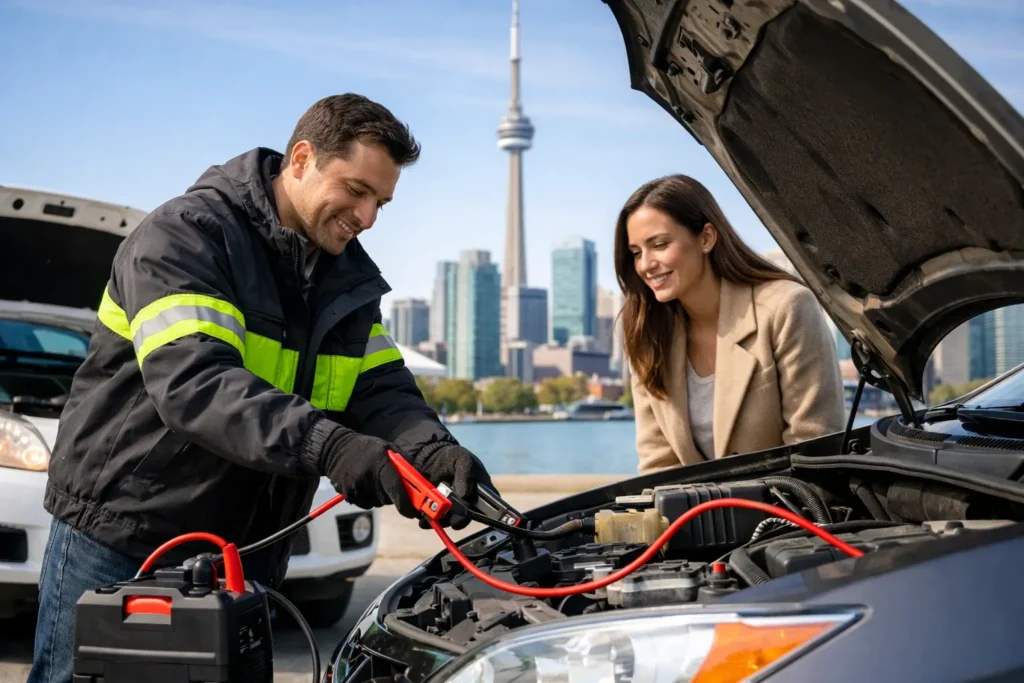
A dead battery has a way of showing up at the worst possible time: outside your home before work, in a parking garage after a late shift, or on a cold Toronto morning when every minute counts. Knowing how to get battery boost help quickly can keep a frustrating delay from becoming an unsafe roadside situation.
The goal is not simply to get the engine running. It is to get help safely, avoid damage to your vehicle’s electrical system, and identify whether the battery was the real problem in the first place. A proper boost can get you moving again. Repeated no-starts may mean the battery, alternator, cables, or another electrical component needs attention.
How to Get Battery Boost Safely
First, make sure you are in a safe location. If your vehicle is stopped in traffic, near a blind corner, on a highway shoulder, or in an area where you do not feel secure, turn on your hazard lights and move away from traffic if you can do so safely. Do not stand between vehicles or attempt a jump-start where passing cars may put you at risk.
If you are parked safely, check for the common signs of a weak or dead battery. Your dashboard lights may be dim or completely off. You may hear rapid clicking when you turn the key, or the engine may crank slowly without starting. In some vehicles, the electronics may appear to work normally while there is not enough battery power to start the engine.
Before arranging a boost, turn off accessories that draw power, including headlights, cabin lights, heated seats, audio systems, and phone chargers. Put the vehicle in park or neutral, engage the parking brake, and keep the hood closed until help arrives unless it is safe and you know how to open it.
For drivers across Toronto, the fastest option is often a professional roadside battery boost. A trained operator arrives with the right equipment, checks the situation, and can help avoid the common mistakes that happen when drivers borrow cables from another vehicle in a rush. Emergency Roadside Service by South Toronto provides 24/7 dispatch support for drivers who need a fast, reliable jump-start without guessing which cable goes where.
What to Tell the Dispatcher
Clear details help roadside assistance reach you faster and bring the appropriate equipment. Be ready to provide your exact location, the make and model of your vehicle, and whether you are in a garage, driveway, street parking space, or highway shoulder. If you are in a parking garage, share the entrance, level, height restrictions, and nearest elevator or landmark.
Mention any warning signs you noticed before the battery died. For example, tell the dispatcher if the battery light came on while driving, the vehicle stalled, you smelled burning, or the battery case appears swollen or leaking. Those details can indicate a problem beyond a simple discharged battery.
If you drive a hybrid or electric vehicle, say so immediately. These vehicles may have a separate 12-volt battery, but their systems should be handled according to the manufacturer’s procedures. A conventional boost approach is not always appropriate.
Should You Try to Jump-Start It Yourself?
A DIY jump-start can work when you have quality cables or a compatible jump pack, a safe place to work, and confidence in the process. But it is not the right choice for every situation. Modern vehicles have sensitive electronics, battery locations that are not always obvious, and designated jump points that differ by model.
Do not try to boost a battery that is cracked, leaking, severely corroded, frozen, or visibly swollen. Batteries can release explosive gas, and damaged units create a real safety risk. You should also avoid connecting cables if you are unsure which terminals are positive and negative, if the donor vehicle has a different electrical system, or if your vehicle manual gives special instructions.
If you choose to use jumper cables, both vehicles should be off, secured in park or neutral, and positioned so they do not touch. Connect the positive cable to the dead battery’s positive terminal first, then to the donor battery’s positive terminal. Connect the negative cable to the donor battery’s negative terminal, then attach the final negative clamp to an unpainted metal grounding point on the disabled vehicle, away from the battery.
Start the donor vehicle, allow it to run briefly, then attempt to start the disabled vehicle. Once it starts, remove the cables in reverse order. Keep hands, clothing, and cables clear of belts, fans, and moving engine parts throughout the process.
Even when the steps sound straightforward, there are trade-offs. A wrong connection can cause sparks, blow fuses, damage electronics, or create a fire hazard. If you are on a busy street, in bad weather, or feeling uncertain, waiting for professional battery boost service is the safer call.
What to Do After Your Vehicle Starts
Do not assume the problem is solved just because the engine is running. Let the vehicle run and drive it for at least 20 to 30 minutes when conditions allow. This gives the charging system time to replace some of the energy lost from the battery. Avoid shutting the engine off immediately at a gas station or store, because it may not restart.
That said, driving around is not a cure for a failing battery or alternator. If the vehicle starts only with a boost, the battery may no longer hold a charge. If the battery warning light stays on after the engine starts, the alternator may not be charging correctly. A failing alternator can leave you stranded again even with a newer battery.
Watch for dimming headlights, flickering dashboard lights, a burning smell, unusual whining sounds, or electronics that cut in and out. These are signs that the charging system may need prompt inspection. If the vehicle stalls or the warning lights appear while you are driving, pull over safely and arrange roadside help rather than continuing to drive.
Why Batteries Fail More Often in Toronto Weather
Cold weather is hard on batteries. Low temperatures reduce the battery’s available power while the engine needs more energy to start. That is why a battery that seems acceptable in mild weather can fail after a freezing night.
Short trips can also contribute. If your regular drive is only a few minutes, the alternator may not have enough time to fully recharge the battery after each start. Add heated seats, rear defrosters, headlights, and phone charging, and the battery can slowly lose ground.
Heat matters too. Summer heat can shorten battery life by accelerating internal wear, even if the battery does not fail until the following winter. Most car batteries last roughly three to five years, but actual lifespan depends on driving habits, weather exposure, vehicle electronics, and battery quality.
When a Battery Boost Is Not Enough
A boost is usually the right solution when the battery was drained by leaving lights on, an accessory stayed plugged in, or cold weather weakened a battery that is otherwise healthy. It may also get you home or to a repair shop after an isolated no-start.
Call for a tow or further inspection instead if the engine will not crank after a proper boost, starts and immediately dies, or the battery light remains on. The same applies if there is smoke, a burning odor, leaking fluid near the battery, damaged cables, or signs of a collision. Those situations can point to a mechanical or electrical issue that a jump-start cannot fix.
For commercial drivers, delivery vehicles, and families traveling with children, it is often smarter to act early. A quick roadside assessment can prevent a second breakdown later in the day, when you may be farther from home or stopped in a less safe location.
Prevent the Next Dead Battery
Small habits make a difference. Check that lights are off before leaving the vehicle, avoid leaving accessories plugged in overnight, and have the battery tested if it is more than a few years old. Clean, tight battery terminals also help the charging system work as intended.
Keep a reliable jump pack in your vehicle if you are comfortable using one, but do not treat it as a substitute for maintenance. A jump pack is useful for an occasional drained battery. If you need it repeatedly, schedule a battery and charging-system test.
When your vehicle will not start, focus first on your safety and location. Fast help is valuable, but the right help matters more: a careful battery boost, clear answers about what happened, and a plan that keeps you from facing the same problem again at the next stop.