A breakdown can turn dangerous in seconds on the Gardiner, the 401, a busy downtown street, or even a dark residential road. If you are searching how to secure disabled vehicle situations, focus first on people, not the car. Your goal is to get out of traffic if possible, make your vehicle visible, avoid unnecessary exposure to passing vehicles, and arrange qualified help quickly.
Secure the Vehicle Only When It Is Safe
The safest place for a disabled vehicle is completely off the active roadway. If the vehicle still rolls, steers, and can move without creating a greater risk, guide it to a shoulder, parking lot, side street, or other safe location. Do not try to push a vehicle across traffic, through an intersection, or up a hill. A stalled car can be replaced. You cannot take back a risky decision made beside fast-moving traffic.
Once you have stopped, shift into Park for an automatic transmission or neutral for a manual transmission, then apply the parking brake firmly. Turn the steering wheel away from traffic if you are parked on a slope or close to the curb. Shut off the engine if you smell fuel, see smoke, notice steam, or suspect engine damage.
If you cannot move out of a live lane, do not get out and attempt roadside repairs. Keep your seat belt on, turn on the hazard flashers, and call emergency services if the vehicle is creating an immediate traffic danger. Tell dispatch your exact location, direction of travel, nearby exit, intersection, or recognizable landmark.
Make Your Disabled Vehicle Easy to See
Hazard lights should be on as soon as you recognize there is a problem. They give approaching drivers an earlier warning that your vehicle is stopped or moving much slower than normal. At night, during rain, snow, fog, or heavy Toronto traffic, visibility matters even more.
Use headlights, parking lights, or interior lights only when they improve visibility without draining a weak battery further or causing confusion for other drivers. If you have reflective triangles, road flares, or LED warning beacons, use them only if you can place them without entering danger. On a high-speed road, it may be safer to leave the warning device in the car than to walk along the shoulder.
Do not rely on hazard lights alone to protect you. Drivers may be distracted, unable to see around a curve, or traveling too fast for conditions. Positioning yourself away from the travel lanes is the real priority.
Know When to Stay Inside and When to Exit
There is no one answer for every breakdown. It depends on traffic speed, road design, weather, visibility, and the condition of your vehicle.
On a busy highway or narrow shoulder, staying inside with your seat belt fastened is often safer than standing beside the vehicle. Keep doors locked, avoid opening the hood, and call for assistance. If you must exit because of fire, smoke, a fuel leak, or a collision risk, leave through the door farthest from traffic. Move well away from the road, ideally behind a barrier if one is available.
On a quiet street, in a parking lot, or safely off the road, passengers can wait away from the vehicle in a visible, secure area. Children and pets should never wander near traffic. Keep everyone together and account for each person before you contact roadside assistance.
Prevent the Vehicle From Moving
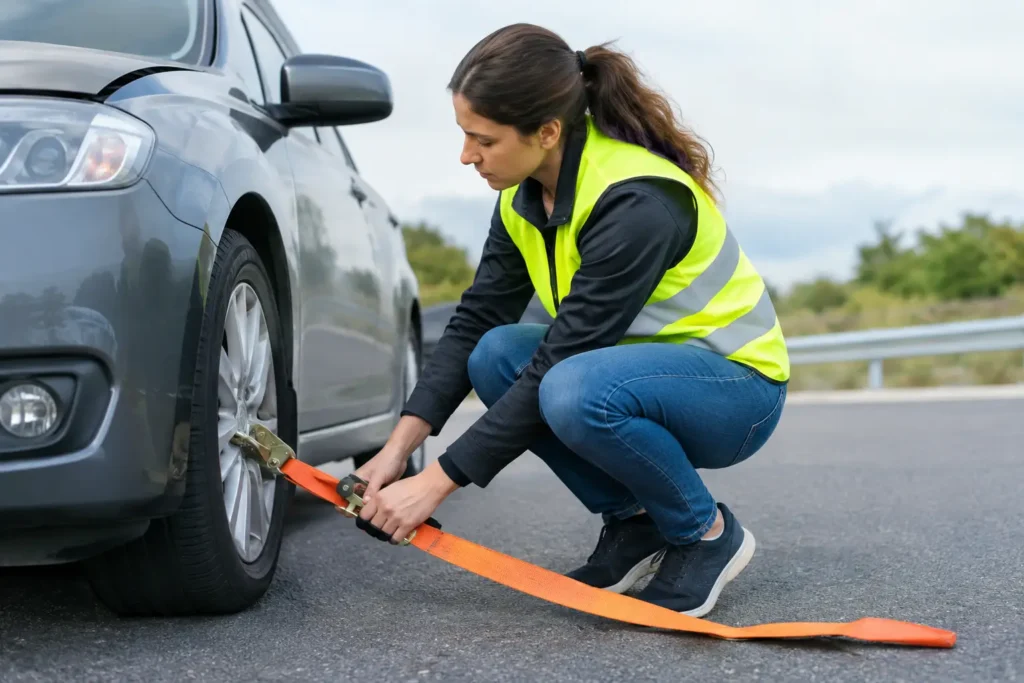
A secure disabled vehicle should not roll, coast, or shift unexpectedly while you wait for help. The parking brake is your first line of defense, but it is not the only one. If you carry wheel chocks, place them against the downhill side of a tire after the vehicle is safely parked. A solid curb can also help limit movement when you turn the wheels toward it.
Avoid using loose rocks, plastic objects, or random debris as makeshift wheel chocks. They can fail under the vehicle’s weight and place you in a dangerous position. Do not crawl under the car to inspect damage or try to secure a hanging part. A professional tow operator has the equipment to stabilize and load the vehicle correctly.
For a flat tire, do not begin changing it on a narrow shoulder, beside high-speed lanes, or where the ground is soft or uneven. A jack can slip, and passing traffic leaves very little margin for error. Mobile tire service or a tow to a safe repair location is often the better choice.
Protect Yourself While You Wait
After the vehicle is secured, make yourself hard to target and easy for help to locate. Lock the doors if you remain inside. Keep your phone charged if possible, and conserve battery by closing unnecessary apps. If you are calling for service, provide the vehicle make, model, color, plate number if requested, the issue you noticed, and your precise location.
Be cautious with strangers who stop and offer help. Many people mean well, but you do not need to accept a ride, hand over keys, or let an unknown person tow your vehicle. If someone claims to be a service provider, ask for identification and verify that they were dispatched for your vehicle before allowing work to begin.
If you have been in a collision, take photos and exchange information only when the scene is safe. Move to a safer place when permitted, and call police or emergency responders for injuries, major damage, blocked lanes, suspected impaired driving, or any immediate hazard.
Avoid Common Disabled Vehicle Mistakes
Stress encourages quick decisions, and some of the most common choices create bigger risks. Avoid these four mistakes:
- Standing between your vehicle and traffic while checking under the hood or inspecting a tire.
- Accepting an unverified tow or unclear pricing from someone who appears without being called.
- Driving farther with overheating, smoke, low oil pressure, braking trouble, or a severe tire problem.
- Leaving passengers exposed on the shoulder when there is a safer protected area nearby.
It can be tempting to keep driving until you reach home or a shop. That may turn a dead battery or minor mechanical warning into engine damage, a tire failure, or an accident. Stop as soon as you can do so safely, then get a proper assessment.
Choose the Right Help for the Problem
The type of assistance should match the situation. A dead battery may need a jump start, while a lockout requires non-damaging entry. A flat tire may be resolved with a mobile tire change if the location is safe. A collision, drivetrain problem, EV issue, or vehicle that cannot be driven should generally be handled with the appropriate tow equipment, often a flatbed.
For drivers across Toronto and the GTA, Emergency Roadside Service by South Toronto can coordinate 24/7 towing and roadside support for breakdowns, lockouts, fuel delivery, tire problems, jump starts, and more complex recovery needs. Ask for the estimated arrival time, the service being dispatched, and the expected price before work begins. Clear information reduces uncertainty when you are already dealing with a stressful situation.
Build a Safer Breakdown Kit Before You Need It
A few practical supplies can make a roadside delay less stressful: a charged phone cable, reflective vest, flashlight, warm blanket, basic first-aid kit, water, ice scraper, and tire pressure gauge. Keep your roadside assistance contact information in your phone and written down in the glove box.
Still, equipment does not replace judgment. The right move is not always to fix the car yourself. When traffic, weather, or location makes the scene unsafe, stay protected, keep the vehicle visible, and let a trained operator handle the recovery. A calm call for help is often the fastest way to get moving again safely.