A dead battery on the Gardiner, a flat tire during a Scarborough commute, or a collision in downtown traffic creates one urgent question: who is paying for the tow? Towing versus insurance is rarely as simple as “my policy covers it” or “I have to pay everything myself.” The right answer depends on why your vehicle stopped, the coverage you selected, where the vehicle needs to go, and whether police or a property owner ordered the removal.
Your first job is not decoding policy language. It is getting yourself, your passengers, and your vehicle out of danger. Once the immediate situation is under control, you can make a clear decision about a tow, a claim, and the costs involved.
Towing Versus Insurance: The Basic Difference
Towing is the immediate service: a licensed operator moves your disabled, damaged, or illegally parked vehicle from one location to another. Insurance is the financial protection that may reimburse or directly cover some of that service under the terms of your policy.
A tow operator cannot determine what your insurer will approve. Likewise, an insurance policy does not make a disabled vehicle safe while it is stopped on an active road. Treat these as two separate needs. Call for prompt roadside help when you need it, ask for transparent pricing before service begins when possible, and then check your policy or contact your insurer about reimbursement or claim handling.
Many drivers assume full coverage automatically includes unlimited towing. It may not. Roadside assistance or towing reimbursement is often an optional endorsement with limits on distance, dollar amount, number of calls, or the type of mechanical failure covered. Collision coverage can be different again, especially after an accident.
When Insurance May Pay for a Tow
Your policy may cover a tow in several common situations. The details vary by insurer, but these are the questions that usually matter.
Breakdown coverage and roadside assistance
If you purchased roadside assistance, emergency road service, or towing and labor coverage, a tow for a mechanical breakdown may be included. This is often useful for a vehicle that will not start, overheats, has a flat tire without a usable spare, or cannot be safely driven after a warning light or mechanical failure.
Read the limit carefully. A plan may pay only to the nearest qualified repair facility, only up to a specified mileage, or only up to a set dollar amount per incident. If you request a longer tow to your preferred mechanic, home, dealership, or another city, you may be responsible for the difference.
Roadside coverage can also help with jump starts, lockouts, fuel delivery, and tire changes. However, the service call may be covered while replacement fuel, a new tire, parts, or repairs are not. The distinction matters when you are comparing an inexpensive service call with the total cost of getting back on the road.
Collision or accident-related towing
After a crash, towing can be part of an insurance claim if the damage makes the vehicle unsafe or impossible to drive. Collision coverage may apply when your car hits another vehicle or object. Comprehensive coverage may apply after certain non-collision events, such as vandalism, theft recovery, falling objects, or weather damage.
Do not assume the other driver’s insurer will immediately arrange your tow, even when the other driver appears to be at fault. Liability decisions can take time. Your own coverage, if available, may be the faster path for immediate vehicle handling. You can then work with your insurer on the claim process.
If police, fire personnel, highway authorities, or a property owner direct that the vehicle be removed, ask where it is being taken and get the tow company’s information if you can safely do so. A quick decision at the scene can prevent confusion later, particularly if the vehicle is taken to a storage lot.
Rental-car and credit-card benefits
Some rental agreements and credit cards offer roadside benefits, but the terms can be narrow. They may apply only to the rental vehicle, require you to call a designated assistance line first, or exclude towing caused by negligence, off-road use, or a restricted area.
This coverage can be valuable, but it should not delay a safety decision. If your vehicle is blocking traffic or you are stranded in an unsafe location, arrange help first and save every receipt and service record.
When You May Need to Pay Out of Pocket
Out-of-pocket towing is common, even for insured drivers. It does not mean you made a mistake. It may simply mean your policy does not include roadside coverage, the tow exceeds the plan’s limit, or the event falls outside what the insurer covers.
You may also pay directly when you want the fastest dispatch and plan to submit for reimbursement afterward. In a stressful moment, that can be the practical choice. Ask for an upfront estimate, confirm the destination, and request an itemized receipt showing the service date, pickup location, drop-off location, vehicle details, and charges.
Storage fees are another major issue. If a damaged vehicle is towed after a collision, every extra day at a storage facility can add cost. Contact your insurer promptly, find out whether an adjuster needs to inspect the vehicle, and ask what steps are required before the vehicle can be moved to a repair facility or another approved location.
The Cost Questions to Ask Before a Tow
When it is safe to speak with dispatch, clear questions protect you from surprises. Confirm the estimated arrival time, the base hookup charge, the included towing distance, any per-mile rate beyond that distance, and whether your vehicle needs special equipment.
A standard passenger car may need a conventional tow or a flatbed, depending on its condition and drivetrain. All-wheel-drive, low-clearance, luxury, electric, motorcycle, and heavily damaged vehicles can require a different approach. Flatbed towing is often the safest option for vehicles with accident damage, locked wheels, drivetrain concerns, or EV-specific handling needs.
Also confirm the destination before the truck arrives. The nearest shop is not always the best choice if it is closed, cannot work on your vehicle, or does not have the equipment needed for an EV or commercial vehicle. On the other hand, a long tow to a preferred shop may cost more than your insurance allowance. This is where towing versus insurance becomes a practical trade-off rather than a simple coverage question.
What to Do After a Breakdown or Collision
Start by moving your vehicle out of traffic if it can be done safely. Turn on hazard lights, remain aware of passing vehicles, and avoid standing beside the car on a busy roadway. If the vehicle cannot be moved, get to a safer location when possible and call emergency services if there are injuries, hazards, or a serious collision.
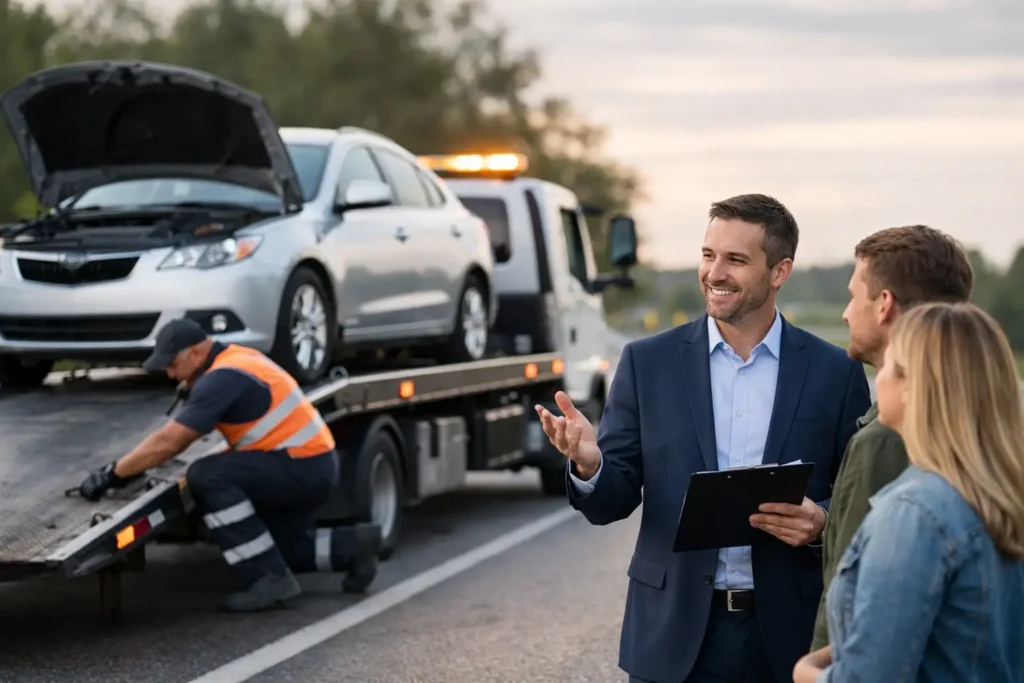
Next, call a professional towing or roadside provider. Tell dispatch your exact location, vehicle type, condition, destination, and any access issues such as an underground garage, parking structure, locked wheels, or accident damage. Accurate details help send the right truck instead of creating a second delay.
Take photos of the vehicle and the scene when it is safe. After a collision, exchange required information and follow local reporting requirements. Keep your tow receipt, repair estimate, claim number, and every message from the insurer in one place. Documentation makes reimbursement and claim conversations much easier.
If you have roadside coverage, call your insurer or assistance provider to ask whether they must dispatch the tow themselves for direct billing. Some plans allow you to choose any qualified provider and submit a receipt. Others require preauthorization or use of a network provider. Getting this answer early can save you a denied reimbursement later.
Choosing Help Without Adding More Stress
The lowest advertised towing price is not always the lowest final cost. A delayed truck, unclear destination, improper equipment, or vague charges can make an already difficult situation worse. Look for a service that offers 24/7 dispatch, clear estimates, properly equipped operators, and experience with the type of vehicle you drive.
For GTA drivers, Emergency Roadside Service by South Toronto coordinates urgent towing, flatbed service, accident towing, EV towing, jump starts, lockouts, tire changes, and fuel delivery with a focus on fast, professional support. The goal is simple: get the right help moving toward you while you stay safe.
Your insurance can help with the bill, but it should never be the reason you wait in an unsafe place. Get the vehicle handled properly, keep your paperwork, ask direct coverage questions, and give yourself the best chance of a smooth claim afterward.