A breakdown on the Gardiner, a collision in Scarborough, or a no-start in a North York parking lot leaves little time for towing research. Still, flatbed towing versus dolly towing can make a real difference to your vehicle, your safety, and the final cost. The right choice depends on how your vehicle is built, what happened to it, and whether it can be safely moved at all.
When you call for help, the goal is not simply to get the car off the road. It is to transport it without adding damage. A professional dispatcher will ask about the vehicle, its condition, drivetrain, wheel damage, and destination before sending the appropriate truck.
Flatbed towing versus dolly towing: the key difference
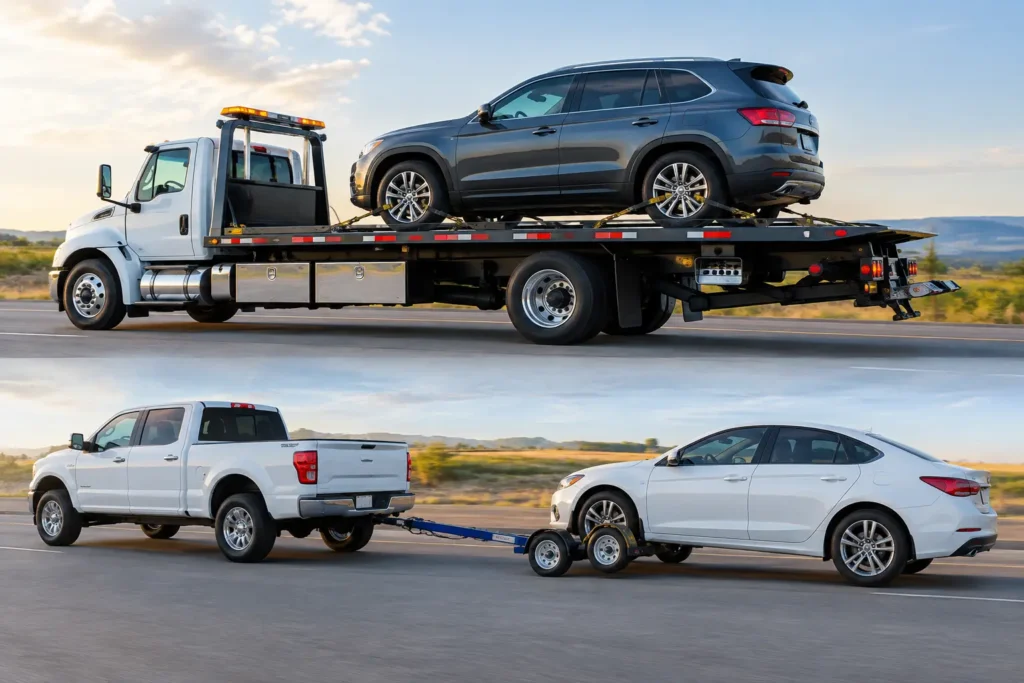
A flatbed tow truck carries the entire vehicle on a level platform. Once loaded and secured, all four wheels are off the ground. The vehicle does not roll during transport, which is why flatbeds are widely used for accident recovery, luxury vehicles, low-clearance cars, electric vehicles, and long-distance towing.
A tow dolly lifts one end of the vehicle, usually the drive wheels, while the other two wheels remain on the road. It can be an effective solution for certain front-wheel-drive vehicles that are in otherwise good condition. Because less equipment is involved and loading can be quick in the right situation, dolly towing may cost less for a short, straightforward tow.
Neither method is automatically right for every call. The safest option comes down to your vehicle’s drivetrain and condition, not just the distance to the repair shop.
When flatbed towing is the safer choice
Flatbed towing is the most protective option because it eliminates road contact for all four tires. That matters when the car has damage that could worsen if it rolls, or when its drivetrain should not be turned by the wheels during towing.
All-wheel-drive and four-wheel-drive vehicles are common examples. With these systems, leaving one axle on the road can create stress inside the drivetrain if the vehicle is not configured exactly as the manufacturer requires. A flatbed avoids that risk by keeping every wheel off the pavement.
Flatbeds are also the preferred choice after a collision. A vehicle may look drivable while hiding a bent suspension component, damaged steering, a flat tire, leaking fluid, or a wheel that no longer tracks straight. Pulling that vehicle on a dolly can be unsafe or cause further damage. A flatbed provides a more stable way to load and move it.
Electric vehicles often need special handling as well. Many EV manufacturers specify flatbed transport because regenerative systems, drive motors, and parking mechanisms can be affected by improper towing. The same caution applies to hybrids and many modern vehicles with electronic parking brakes. The operator should follow the vehicle manufacturer’s towing instructions, not make assumptions based on how the car looks from the roadside.
Choose a flatbed when your vehicle has low ground clearance, damaged wheels, a locked wheel, transmission trouble, steering issues, or an unknown mechanical failure. It is also the smart call for a classic car, exotic vehicle, motorcycle, or any vehicle you want moved with minimal risk.
Flatbeds offer more stability in difficult situations
Toronto roads do not always provide an easy loading area. Tight downtown lanes, busy traffic, construction zones, snow, and poor weather can turn a simple tow into a recovery job. A modern flatbed gives the operator more control over how the vehicle is winched, positioned, and secured.
This does not mean every flatbed loading job is simple. A car resting against a curb, sitting in a ditch, or damaged after a crash may need careful recovery before it can be loaded. In those cases, trained operators and proper equipment matter as much as the truck itself.
When dolly towing can make sense
Dolly towing can be a practical option for a front-wheel-drive vehicle when the front wheels can be lifted safely and the rear wheels, tires, suspension, and steering are in good working order. For example, a car with an engine problem or dead battery may be suitable for a short tow to a nearby shop if there is no collision damage or drivetrain concern.
It can also be useful where access is limited and a full flatbed cannot position easily. A skilled operator evaluates the space, traffic conditions, vehicle height, tire condition, and route before deciding whether a dolly is appropriate.
The trade-off is that two tires remain on the road. Those tires continue to rotate, which means they must be properly inflated, undamaged, and aligned enough for safe travel. A dolly is not the answer for a vehicle with rear-end damage, rear tire damage, a seized wheel, or uncertain suspension condition.
Rear-wheel-drive vehicles require more caution. If the rear wheels are the drive wheels, towing with those wheels on the ground can damage the transmission or drivetrain unless the driveshaft is disconnected or another approved method is used. In many real roadside situations, a flatbed is the cleaner and safer answer.
Cost, speed, and the real value of the right tow
Drivers often ask whether a dolly tow is cheaper. Sometimes it is. For a short tow involving a suitable vehicle, it may require less time and equipment than a flatbed. But the lowest upfront price is not a bargain if the wrong towing method damages a transmission, tire, suspension, bumper, or EV system.
Flatbed service can cost more because the truck, equipment, loading process, and recovery capability are more extensive. It may also be the only responsible option for a damaged, all-wheel-drive, luxury, or electric vehicle. A transparent towing company should explain the recommendation and provide clear pricing before the job begins whenever conditions allow.
Speed is another concern when you are stranded. A dolly does not always mean a faster arrival, and a flatbed does not automatically mean a long wait. Dispatch should send the closest appropriate unit based on the vehicle and the location. The fastest tow is the one that does not require a second truck or create new damage after loading.
What to tell the dispatcher before a tow
Clear details help the dispatcher send the right equipment on the first call. Tell them the make, model, year, and whether the vehicle is front-wheel drive, rear-wheel drive, all-wheel drive, four-wheel drive, hybrid, or electric if you know it. Mention collision damage, flat or missing tires, warning lights, locked wheels, leaks, whether the car is in a garage, and whether it can roll or steer.
If you are unsure about the drivetrain or the damage, say so. Do not guess that the vehicle is safe to dolly tow. Photos can help when dispatch offers that option, especially after a collision or when a wheel is damaged.
While waiting, move to a safe location away from traffic if possible. Turn on hazard lights, keep children and passengers away from the road, and avoid standing between your vehicle and approaching traffic. If the vehicle is in a dangerous live lane, explain that immediately so the dispatcher can prioritize the situation.
Choose protection when the vehicle’s condition is uncertain
For most damaged, all-wheel-drive, electric, low-clearance, or higher-value vehicles, flatbed towing is the safer choice. Dolly towing remains useful for the right front-wheel-drive vehicle on a short, uncomplicated tow, but it requires the vehicle to be in suitable condition.
At Emergency Roadside Service by South Toronto, the focus is on sending the equipment that protects your vehicle and gets you out of a stressful situation quickly. When you call, give the dispatcher the full picture. A few accurate details can prevent delays and help ensure your car arrives at the repair shop in the same condition it left the roadside.